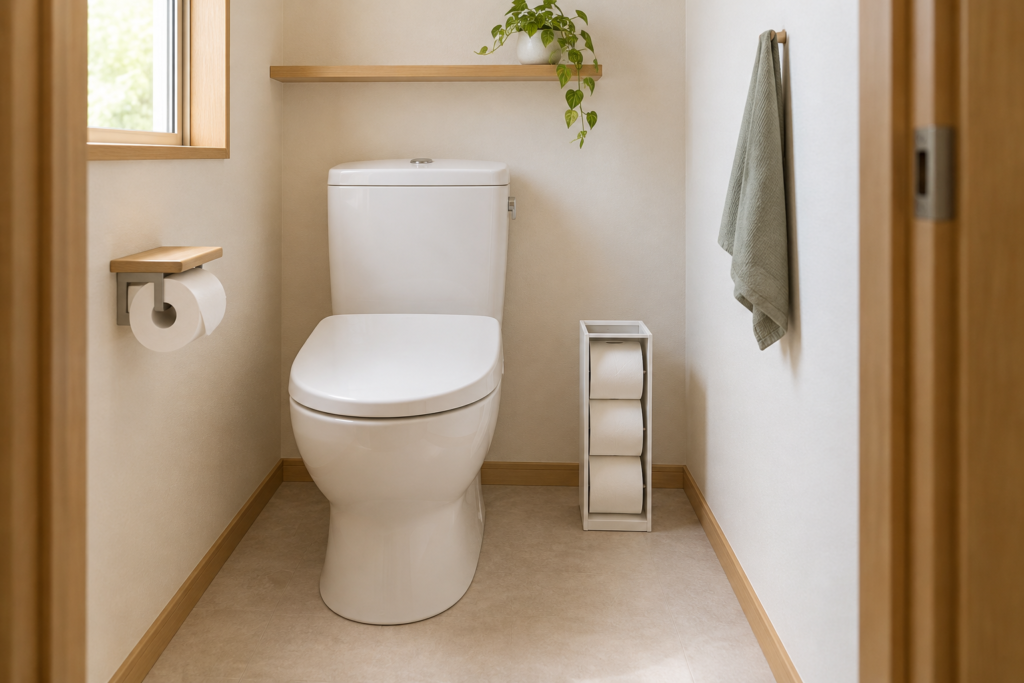
A slim toilet paper holder can fit beside the toilet and still be difficult to use.
The roll may be too wide for the opening. A cabinet door may block access. Or the holder may need to be moved every time the floor is cleaned.
In a small bathroom, start by deciding how many spare rolls you need nearby. Then check the size of the rolls you actually buy and the space needed to remove and replace them.
Research note: We have not personally tested the storage product mentioned below. This guide combines practical planning suggestions with manufacturer information checked on October 27, 2026. The product is a design example, not a performance ranking. External links are reference links, not affiliate links.
- Decide how many rolls need to stay nearby
- Measure your actual rolls
- Measure the storage area and the retrieval movement
- Compare three ways to store spare rolls
- Product example: Plate Toilet Paper Stocker
- Test the position before buying
- Keep extra stock where it is easy to refill
- Start with the rolls you already have
Decide how many rolls need to stay nearby
You do not have to fit an entire multipack beside the toilet.
Start with the number of spare rolls your household would like to keep within easy reach. The remainder can stay in an existing cupboard or another dry storage area.
A smaller holder may be enough if refilling it is easy. On the other hand, a holder that needs constant refilling may not suit your routine.
Consider who uses the bathroom and whether each person can reach and replace a roll comfortably.
Measure your actual rolls
“Standard” toilet paper rolls are not all the same size.
Measure a new, unused roll from the brand you normally buy:
- Diameter: across the circular face at its widest point.
- Width: from one flat end to the other.
- Core opening: relevant for holders that use a central rod.
Also check whether the roll keeps its shape when its packaging is removed.
A large or extra-long roll may have different dimensions from a smaller roll in the same store. Confirm compatibility with the exact holder rather than relying only on the advertised number of rolls.
Measure the storage area and the retrieval movement
A holder’s footprint is only the starting point.
| What to check | Why it matters |
|---|---|
| Available width and depth | The holder needs a stable place to sit |
| Height and overhead clearance | A top-loading design needs room for refills |
| Opening direction | You need space to remove a roll |
| Door and drawer clearance | The holder should not obstruct opening |
| Cleaning access | You may need to move or reach around it |
For a side-opening holder, check which side faces the wall. For a top-loading holder, allow room to lift the lid and insert a roll.
If the toilet room and bathing area share a space, choose a location where spare paper is protected from water.
Compare three ways to store spare rolls
Use an existing cupboard or shelf
An existing dry shelf may be enough for a few spare rolls.
Check that the rolls are easy to see and reach, and that they will not tumble when the cupboard opens.
When to skip: The only suitable shelf is difficult to reach, or every refill requires moving several other items.
Choose a freestanding holder
A freestanding holder can provide a defined place without wall installation.
Check the full footprint, the way rolls are loaded and removed, and the room needed to move the holder for floor cleaning.
When to skip: It obstructs the door, makes the space uncomfortable to use, or requires lifting the entire holder whenever someone needs a roll.
Use a wall-mounted holder or shelf
Wall storage can leave the floor clear, provided the surface and fixing method are suitable.
Check the installation requirements, stated load limit, and roll compatibility. A rod-style holder may also specify a minimum core diameter.
For rentals, confirm that the proposed fixing method is permitted. Pins and adhesive products may leave marks depending on the surface and removal.
When to skip: The wall is unsuitable, installation is not permitted, or the loaded holder projects into a narrow passage.
Product example: Plate Toilet Paper Stocker
Yamazaki Home’s Plate Toilet Paper Stocker – Steel is an example of a freestanding, enclosed stocker with openings on both sides.
| Item | Manufacturer’s published information |
|---|---|
| Listed size | 12.88 × 4.88 × 19 inches |
| Stated capacity | 8–12 rolls |
| Maximum roll diameter | 5.1 inches |
| Roll access | Openings on both sides |
| Loading | From the top |
The stated capacity should not be assumed for every roll size. Check the width as well as the diameter of the paper you use, and leave space beside an opening to take out a roll.
Check the product page for current availability before purchasing.
Test the position before buying
Place an empty box or another harmless object in the proposed footprint, then rehearse the routine:
- Open the door and any nearby cupboard.
- Reach the place where the next roll would come out.
- Check the space needed to refill from above or from the side.
- Move around the area as you normally would.
- Check how you would clean the floor.
Remove the temporary object after the test.
If the spot works only when the door is partly closed or another item is moved, try a different location.
Keep extra stock where it is easy to refill
A small bathroom does not need to hold every spare roll.
Choose one nearby location for the next few rolls and another suitable place for the rest. Refill the bathroom holder when convenient, rather than choosing a larger unit that crowds the room.
For other small-bathroom supplies, our guide to organizing under a small bathroom sink explains how to check pipes and usable storage space.
Start with the rolls you already have
The most useful storage is one that fits your paper, keeps it accessible, and leaves the room comfortable to use.
Measure a new roll, decide how many you want nearby, and test the retrieval and refill movements.
You may find that an existing shelf already does the job.
Small spaces. Thoughtful solutions. Inspired by Japan.