A bag looks neatly stored on a shelf—until its shoulder strap slips into the walkway.
A hook clears the floor—until a full work bag sticks out beside the door.
In a small entryway, the useful question is not simply where a bag fits. It is where you can put it down, reach its contents, and pick it up again without obstructing the room.
Start with the bag you actually carry, in its usual loaded shape.
Research note: We have not personally tested the organizer mentioned below. This guide combines practical planning suggestions with manufacturer information checked on October 26, 2026. The product is a design example, not a performance ranking. External links are reference links, not affiliate links.
- Keep only everyday bags near the entrance
- Measure the bag with its usual contents
- Compare three storage methods
- Product example: separate bases and movable dividers
- Check doors and the walking route
- Give straps and contents a place
- Try one bag before buying a larger system
- Choose storage that follows your routine
Keep only everyday bags near the entrance
You do not need to store your whole collection in the entryway.
Start with the bags currently used for work, school, or regular errands. Occasional bags can have a separate home elsewhere.
Decide whether you need a temporary landing place or a longer-term storage location.
If you empty your work bag at a desk every evening, a storage position near that desk may suit your routine better than a new rack beside the front door.
Measure the bag with its usual contents
An empty tote can look much slimmer than the same bag holding a lunch box and water bottle.
Measure the bag in the condition in which you normally put it away.
| What to check | Why it matters |
|---|---|
| Loaded width and depth | The bag may extend beyond the organizer |
| Height including handles | A shelf above may obstruct removal |
| Strap length and position | Loose straps can catch or trail onto the floor |
| Weight as normally carried | A hook must suit the load and fixing method |
| Space to grip and lift | A bag that fits tightly may be awkward to retrieve |
For a soft bag, also check its shape when partly empty. It may slump into the next compartment.
A divider can separate bags, but it should not be treated as a guarantee that every bag will stand upright.
Compare three storage methods
An existing shelf or cubby
A clear shelf can provide a simple place to set down one everyday bag.
Check that the bag rests securely on its base and does not project into the walking route. Leave enough space above to grip the handles without scraping against another shelf.
Check the shelf’s stated load limit where applicable.
When to skip: The bag tips forward, straps hang into the passage, or reaching it requires moving shoes and other items.
A shelf organizer with dividers
Dividers can give bags separate positions and reduce the need to move one bag to reach another.
Adjust the spacing around the bags you use. Do not force a bulky bag into a narrow slot simply to fill every compartment.
Measure the organizer and the loaded bags together. The divider height does not tell you the total storage height.
When to skip: The base takes up too much shelf space, the bags remain unstable, or the arrangement squeezes their shape.
Hooks or a hanging holder
Hooks can keep the floor clear when the bag and installation method are suitable.
Check the bag maker’s care guidance before choosing hanging storage. Hanging by a narrow handle may not suit every material or construction.
Check the holder’s load limit, the mounting surface, and the complete fixing instructions. Include the contents when assessing the bag’s weight.
When to skip: The bag swings into a doorway, the fixing surface is unsuitable, or the bag’s care instructions do not support that storage method.
Product example: separate bases and movable dividers
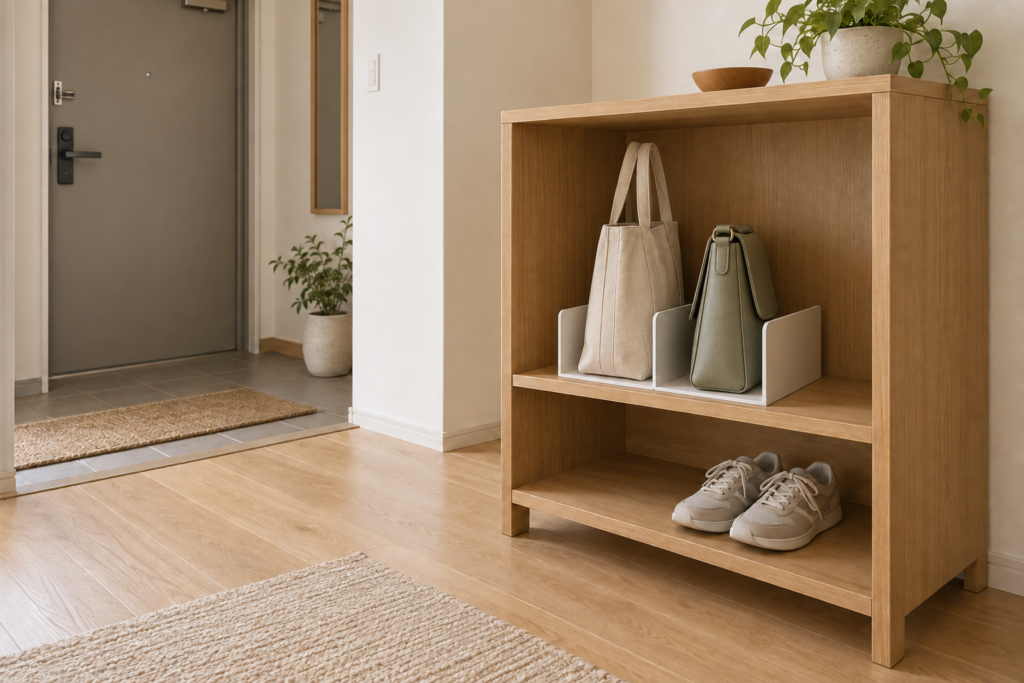
Yamazaki’s Smart Handbag Organizer (Set of 2) illustrates a shelf-based approach.
| Item | Manufacturer’s published information |
|---|---|
| Included bases | Two |
| Included vertical dividers | Eight |
| Base arrangement | Use separately or connect together |
| Divider arrangement | Insert into grooves to suit bag spacing |
Check the product page for current availability before purchasing.
Count the base pieces as well as the compartments shown in photographs. You may need only one base for the everyday bags near your entrance.
This is a freestanding organizer for a suitable surface, not a wall-mounted holder. Check the actual dimensions and available shelf space before ordering.
Check doors and the walking route
Test the storage position with the bag in place.
Open the entrance door, nearby cupboard doors, and any drawers that share the space.
Then try the movements you usually make: putting on shoes, carrying groceries inside, and picking up the bag.
Keep the route through the entryway clear. A storage position that works when everyone is standing still may become awkward during a busy departure.
If the organizer fits but the bag protrudes, judge the complete arrangement rather than the organizer alone.
Give straps and contents a place
Arrange shoulder straps so they do not trail onto the floor or catch in a door.
Avoid adding a second hook just because a strap hangs down. First check whether the bag can sit in a different orientation or whether the strap can rest naturally beside it.
If you regularly transfer keys or other small items out of the bag, give them a defined nearby location. Our guide to storing keys and everyday essentials in a small entryway focuses on that separate part of the routine.
Follow the bag maker’s care instructions if the bag is wet or needs cleaning before returning it to enclosed storage.
Try one bag before buying a larger system
Use your most frequently carried bag for a short trial:
- Put it down with its usual contents.
- Arrange the handles and straps.
- Open nearby doors fully.
- Reach the contents you normally remove.
- Pick up the bag without moving another item.
Then repeat with the other everyday bags in place.
If the arrangement becomes crowded, move occasional-use bags elsewhere before buying another organizer.
Choose storage that follows your routine
A small entryway does not need a dedicated place for every bag you own.
It needs a workable home for the bags passing through it today.
Start with one clear position, check the loaded bag and straps, and add storage only where a specific problem remains.
Small spaces. Thoughtful solutions. Inspired by Japan.