A toothbrush holder can fit beside a small sink and still be awkward to use. Toothpaste leans across the brushes, thick handles catch in narrow openings, and the base becomes another object to move whenever you wipe the counter.
Start with the brushes and toothpaste you use each day. Give them enough room to stand securely, be picked up separately, and leave the sink comfortable to use.
- Keep everyday items separate from backups
- Plan for drying as well as storage
- Measure your brushes before choosing a holder
- Compare three storage approaches
- Product example: Tower Toothbrush + Toothpaste Stand
- Separate electric-brush charging from general storage
- Test the arrangement during your normal routine
Keep everyday items separate from backups
Gather the items currently sitting around your sink.
Keep your current toothbrushes and open toothpaste within easy reach. Move unopened toothpaste, packaged replacement brush heads, and travel supplies to a separate storage spot.
You may find that an existing holder is large enough once these extras are removed.
If several people share the sink, make each person’s brush easy to identify. Leave space between brush heads rather than filling every available opening.
Plan for drying as well as storage
The American Dental Association recommends rinsing toothbrushes after use, storing them upright, and allowing them to air dry. Its consumer guidance also recommends keeping brushes separated when they share a holder.
A neat-looking closed box is therefore not automatically a good everyday location for a wet toothbrush.
Choose a layout that allows upright storage and does not press the bristles against a wall, another brush, or the toothpaste tube.
For electric toothbrushes, follow the manufacturer’s cleaning, drying, and charging instructions. A standard toothbrush stand should not be assumed to accommodate the handle or replace its charging base.
Measure your brushes before choosing a holder
The outside dimensions of an organizer tell you how much counter space it needs. They do not tell you whether your brushes fit its openings.
| Measurement | What to check |
|---|---|
| Thickest part of the handle | Whether it passes through or rests securely in the holder |
| Brush length | Whether it clears a shelf or mirror cabinet above |
| Toothpaste tube | Width with the cap fitted and shape when nearly empty |
| Space between brush heads | Whether brushes remain separated in their normal positions |
| Removal clearance | Whether you can lift out one item without catching another |
Check children’s brushes, angled handles, and electric brush heads individually. Do not force a handle through a narrow slot.
If the manufacturer does not publish the opening dimensions, ask before purchasing rather than estimating from the overall width.
Compare three storage approaches
| Approach | Potential advantage | Main tradeoff |
|---|---|---|
| Existing washable holder | Easy to try without buying anything | May collect water or crowd brush heads |
| Divided countertop stand | Gives brushes and toothpaste defined positions | Uses counter space and needs cleaning underneath |
| Mounted holder | Can leave the counter clear | Requires a suitable surface and compatible brush shape |
1. Improve the holder you already own
Before replacing a cup or holder, remove items that do not need to stay beside the sink.
Check whether the remaining brushes stand securely and whether their heads stay separated. Keep toothpaste beside the holder if placing it inside pushes the brushes together.
Choose a position you can reach without stretching across the faucet. Empty collected water and clean the holder according to its material and care instructions.
When to skip: Replace or repurpose it if brushes repeatedly tip over, the heads crowd together, or the inside is difficult to reach for cleaning.
2. Use a divided countertop stand
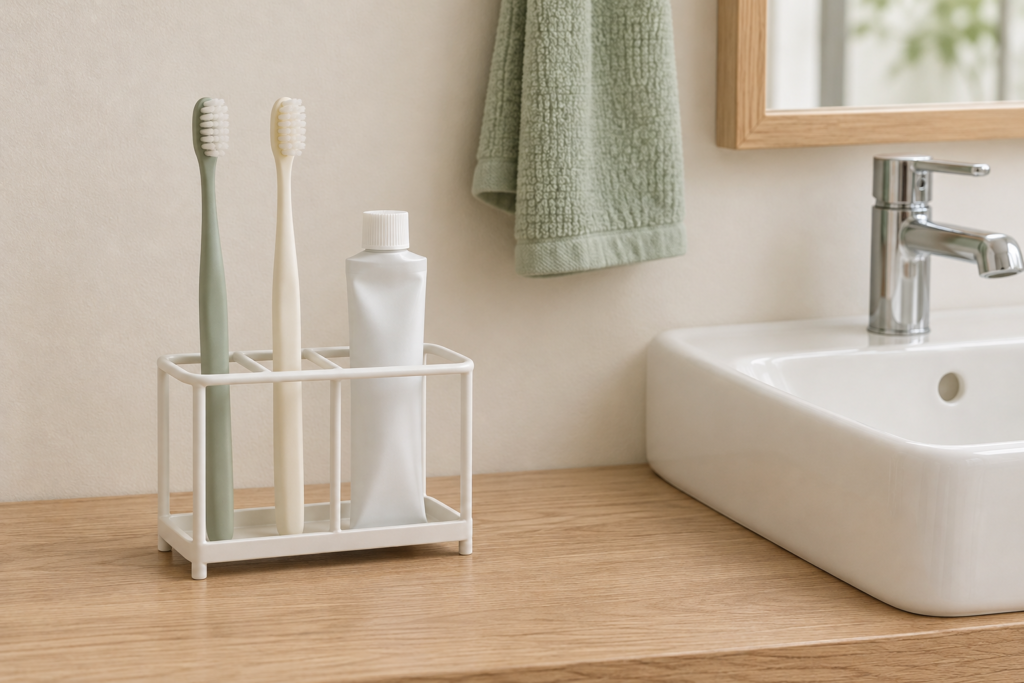
A divided stand can help when you want a separate place for each brush and an open toothpaste tube.
Look at the base as well as the top dividers. Can you reach the areas where water and toothpaste residue collect? Can removable parts be taken out without dismantling the whole setup?
Leave room to lift the stand and wipe the counter underneath.
When to skip: A stand is a poor fit if it sits partly on a curved sink edge or leaves too little space for washing your hands.
3. Consider a mounted holder
A wall-mounted holder can free the small ledge beside the sink, but its mounting method needs to match the surface.
For adhesive or suction products, check the manufacturer’s surface requirements, preparation steps, load rating, and any waiting period before use. For magnetic holders, confirm that the intended surface is suitable.
Position the brushes where they are accessible without obstructing a mirror cabinet, faucet, or nearby switch.
When to skip: Choose a freestanding option if the surface is incompatible, mounting is prohibited, or removing the holder would damage the finish.
Product example: Tower Toothbrush + Toothpaste Stand
Yamazaki’s Tower Toothbrush + Toothpaste Stand is a compact freestanding example.
| Specification | Manufacturer information |
|---|---|
| Model shown on the U.S. page | 6802 |
| Outside dimensions | 4.33 in wide × 1.97 in deep × 3.15 in high |
| Weight | 0.51 lb |
| Main material | Steel |
| Origin | Designed in Japan; made in China |
The Japanese manufacturer page for this model describes space for six toothbrushes and one toothpaste tube, with a removable silicone mat.
Treat that capacity as a layout reference rather than a guarantee for every handle shape. Check compatibility separately for electric toothbrushes, wide children’s handles, and large toothpaste tubes.
Check the product page for current availability before purchasing.
Separate electric-brush charging from general storage
An electric toothbrush may need a different arrangement from manual brushes.
Check the manufacturer’s instructions for the charging base and required placement. Allow room for the base, the handle, and the cable without routing the cord across the basin.
Keep packaged spare heads elsewhere so they do not crowd the daily setup. If you use a holder for an unpackaged brush head, check that it supports that specific shape and allows the head to be removed easily.
Test the arrangement during your normal routine
Before buying more storage, try your proposed layout for a few days.
Check whether you can:
- Pick up your own brush without moving another.
- Return it upright without the bristles touching nearby objects.
- Reach the toothpaste without knocking over a brush.
- Open the mirror cabinet fully.
- Lift the holder and wipe beneath it.
If rearranging your existing holder solves these problems, a new organizer may not be necessary.
For the surrounding area, see our guides to towel storage in a small bathroom and organizing under a small bathroom sink.
A useful toothbrush setup leaves room for daily use, drying, and cleaning—not just the items themselves.
Sources: American Dental Association toothbrush guidance and the manufacturer pages linked above. Product information checked on November 6, 2026. This is a research-based guide, not a hands-on product review.
Small spaces. Thoughtful solutions. Inspired by Japan.