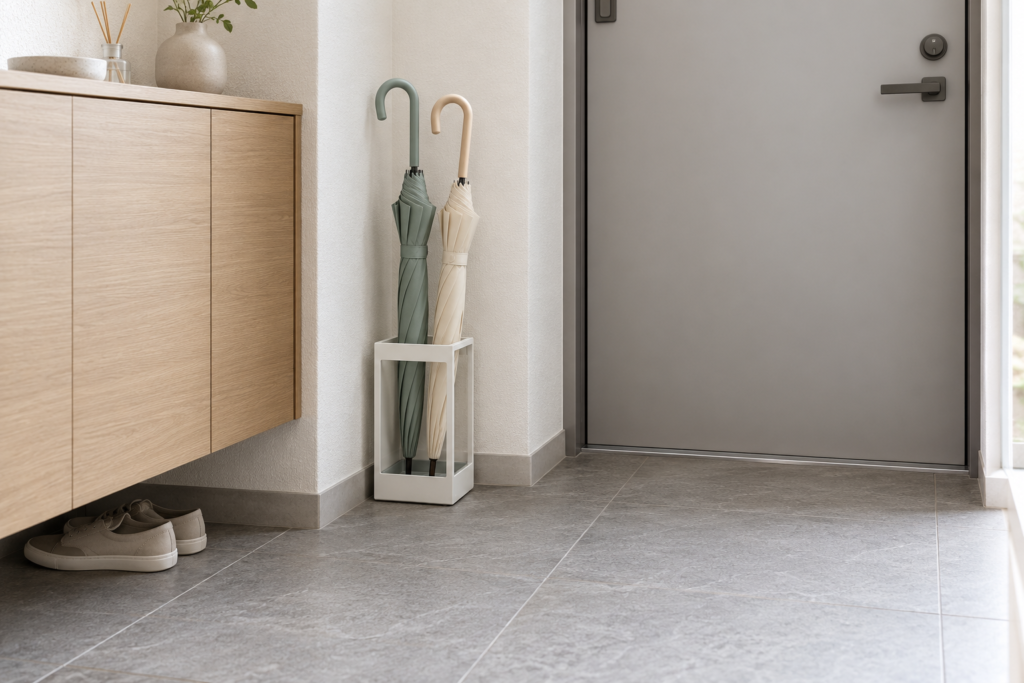
A small umbrella stand can fit neatly beside the door—until wet umbrellas, bulky handles, and a pair of shoes compete for the same corner.
In a small entryway, it helps to plan for two different situations: arriving home with a wet umbrella and storing a dry one between uses.
These do not always need separate organizers. They do need a routine that keeps water contained and the doorway clear.
Start with the umbrellas you actually use
Gather your umbrellas before choosing storage.
Separate full-length umbrellas from compact folding ones, and identify which are used regularly. Put occasional-use umbrellas elsewhere once they are completely dry.
If you mainly carry one folding umbrella, an existing shelf position may be enough. A large stand could use more room than your routine requires.
Keep a practical amount of spare capacity for your household rather than choosing storage around every umbrella you have ever collected.
Plan the wet-umbrella routine first
Think about what happens when you open the door carrying an umbrella, a bag, and shopping.
Choose a temporary position where drips can be contained without wetting shoes or creating a puddle in the walking route.
Then decide where the umbrella can dry according to its care instructions. A compact holder that keeps umbrellas tightly bundled should not automatically be treated as a drying station.
Before returning an umbrella to enclosed storage or its fabric sleeve, let it dry. Empty collected water and dry the receiving tray as needed.
If an umbrella needs to be opened for drying, use an appropriate space where it will not obstruct movement. Keep shared corridors and exits clear.
Measure more than the base
The base of a stand may be small, but umbrella handles can extend beyond it.
| What to check | Why it matters |
|---|---|
| Width and depth with umbrellas inside | Handles and folded fabric may project outward |
| Height of the tallest umbrella | It may interfere with a shelf or door hardware |
| Space above the holder | You need room to lift an umbrella out |
| Door and cabinet movement | Storage must not prevent full opening |
| Access to the water tray | Cleaning should not require dismantling the entryway |
Try placing your umbrellas in the proposed position before buying a holder. Open nearby doors and walk past while carrying your usual bag.
A corner is useful only if the umbrellas remain easy to reach and out of the way.
Compare three storage methods
| Method | Potential advantage | Main tradeoff |
|---|---|---|
| Compact freestanding stand | Works without a compatible door or wall | Uses floor space and needs a stable position |
| Magnetic holder | Can keep the floor clear | Requires a suitable mounting surface |
| Cabinet storage for dry umbrellas | Keeps occasional-use umbrellas out of sight | Requires drying elsewhere and enough internal clearance |
1. A compact freestanding stand
A small stand can suit a household with a few everyday umbrellas and an unused floor corner.
Look at the water collection area, how easily it can be cleaned, and whether your umbrellas fit without being forced into the openings.
Check stability with your actual umbrella mix. A large handle, a long shaft, or an uneven arrangement may change how the loaded stand behaves.
When to skip: Avoid a floor stand if it occupies the space needed for removing shoes, opening the door, or moving through the entryway.
2. A magnetic holder on a compatible surface
A magnetic holder may suit a compatible steel entrance door or another manufacturer-approved surface.
Check the required surface, mounting instructions, and load limit. A door that looks metallic is not necessarily suitable.
Allow for the umbrellas as well as the holder. Check clearance around the handle, lock, door closer, and nearby wall throughout the door’s movement.
Also check how drips are handled. Some products support umbrellas without providing a water-catching base.
When to skip: Choose another method if the surface is unsuitable, attachments are prohibited, or loaded umbrellas interfere with opening and closing the door.
3. Cabinet storage for fully dry umbrellas
A shoe cabinet or entryway cupboard may already have space for spare umbrellas.
Measure the internal height and depth, including shelves, hinges, and the umbrella handle. Give folding umbrellas a visible position so that they do not disappear behind other items.
Keep wet umbrellas out of enclosed shoe storage. Plan where they will dry before returning them.
When to skip: This method becomes inconvenient if you must move shoes or several other items every time you need an umbrella.
Product example: Smart Umbrella Stand
The Smart Umbrella Stand from Yamazaki is one example of a compact freestanding design.
| Specification | Manufacturer information |
|---|---|
| Overall size | W11 × D11 × H30 cm |
| Listed capacity | Up to four umbrellas |
| Materials | Steel and polypropylene |
| Tray arrangement | Adjustable for long or folding umbrellas |
| Origin | Designed in Japan; made in China |
The two enclosed sides are intended for corner placement. Adjustable trays allow different storage arrangements.
The linked page is Yamazaki’s European manufacturer page. Use it as a specification reference, and check delivery coverage and current availability for your location.
The listed capacity does not guarantee that every combination of large umbrellas will fit. Check your umbrella handles, folded thickness, and removal space before purchasing.
Try a no-purchase arrangement first
Before adding a stand, try reorganizing what you already have.
Keep fully dry, occasional-use umbrellas on an existing suitable shelf or in a cupboard. Reserve the most accessible position for the umbrellas used regularly.
If you already own a suitable umbrella holder, moving it may solve the problem. A position beside the door may work better than the corner behind it.
You can also use a suitable water-resistant tray you already own to catch temporary drips, provided the umbrella has stable support and the tray stays outside the walking route. A tray alone will not keep a tall umbrella upright.
Do not assume that an ordinary decorative basket or plant pot will contain water without leaking or damaging the floor.
Check the arrangement on a rainy day
A useful setup should work when your hands are full.
Ask yourself:
- Can I put the umbrella down without reaching over shoes?
- Is water contained where I can see and remove it?
- Can the entrance door still open fully?
- Can another person pass while an umbrella is being stored?
- Can I take out one umbrella without pulling the others over?
If the answer is no, reconsider the position before choosing a larger organizer.
For the rest of the entryway, see our guides to storing keys and everyday essentials and storing everyday bags in a small entryway.
A good umbrella-storage routine gives wet umbrellas somewhere practical to pause and dry umbrellas a clear place to return.
Research note: Product information checked against the manufacturer’s official page on November 2, 2026. This is a research-based guide, not a hands-on product review. Follow the umbrella and storage product instructions.
Small spaces. Thoughtful solutions. Inspired by Japan.