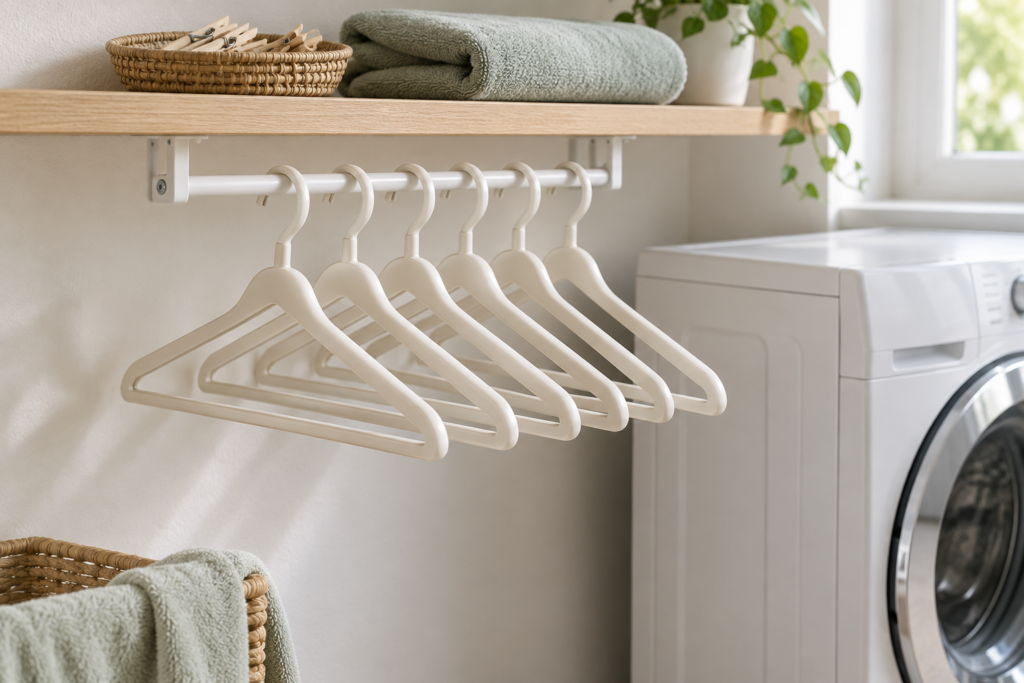
Empty hangers can take up a surprising amount of room. Hooks catch on one another, folding drying hangers slip behind bottles, and a basket that looks tidy can become difficult to use.
In a small laundry area, the aim is to give your hangers a place where you can take one out without pulling everything else with it.
Start with the hangers you actually use, then choose storage around their shape and your laundry routine.
Start with one load of laundry
Before buying an organizer, gather your empty hangers and sort them into three groups:
- Everyday clothes hangers.
- Clip hangers for trousers or skirts.
- Folding drying hangers with multiple clothespins.
Keep the number you need for your usual laundry routine, with a modest reserve if your loads vary. Move occasional-use hangers elsewhere.
If clothes dry on hangers and then go straight into the closet, consider keeping spare hangers there too. Returning every empty hanger to the bathroom may add an unnecessary step.
Measure the hangers, not just the organizer
An organizer’s dimensions do not necessarily describe the space occupied by the hangers on it.
Check these measurements before choosing a location:
| What to measure | Why it matters |
|---|---|
| Width of your largest hanger | Shoulders may extend beyond the holder |
| Depth of the stored bundle | Clips and thick frames need extra space |
| Height of a folded drying hanger | The hook or frame may reach below the storage point |
| Removal space | You need room to lift, slide, or pull an item out |
| Nearby doors and lids | Storage must not obstruct normal opening |
Hold a few hangers in the proposed position and try taking one out. This simple check can reveal an awkward location before you buy anything.
Around a washing machine, follow the appliance’s installation requirements. Keep access to hoses, controls, filters, and service areas clear.
Compare three storage methods
| Method | Potential advantage | Main limitation |
|---|---|---|
| Existing basket or open bin | Easy to try without buying anything | Mixed hooks can become tangled |
| Existing rail | Keeps hangers visible and accessible | Uses hanging space and needs clearance below |
| Dedicated magnetic holder | Can use a suitable metal surface | Requires a compatible surface and room for loaded hangers |
1. Use an existing basket first
A basket can work well for a small collection of similar hangers.
Arrange the hangers in the same direction, with their hooks grouped together. Keep clip hangers separate if their clips catch on the other frames.
Avoid packing the basket tightly. If taking out one hanger lifts the whole bundle, reduce the contents or divide the group.
When to skip: A deep basket may be frustrating if small hangers disappear beneath larger ones or if you need both hands to separate them.
2. Reserve a short section of an existing rail
If you already have a suitable closet rail or laundry rail, give empty hangers a defined section.
This lets you see the available hangers and pick one without searching through a container. Keep the rail’s load limit in mind, including anything else hanging from it.
Check the space below as well. Hangers should not interfere with a laundry basket, shelf, or appliance lid.
When to skip: Avoid using a towel rail that is already needed for drying towels. An organizer is less helpful if it displaces something you use every day.
3. Consider a magnetic holder for a suitable metal surface
A magnetic holder may suit an accessible washing-machine side panel or another compatible steel surface.
Check the mounting instructions, surface condition, and load rating. A metal-looking panel is not necessarily suitable for magnets.
The loaded hangers also need room. A narrow holder can still leave hanger shoulders projecting into a walkway or against a neighboring cabinet.
When to skip: Choose another method if the surface is unsuitable, the appliance manufacturer prohibits attachments, or the gap is too tight to remove hangers comfortably.
Product example: Tower Magnet Laundry Hanger Storage Rack
The Tower Magnet Laundry Hanger Storage Rack is a dedicated organizer from Yamazaki.
| Specification | Manufacturer information |
|---|---|
| Overall size | W6 × D8.5 × H46 cm |
| Internal space per tier | D8 × H22 cm |
| Weight | 520 g |
| Main material | Powder-coated steel |
| Static load capacity | Rack: 3 kg; each hook: 250 g |
| Accessories | Magnet, three hooks, two wood screws |
| Origin | Designed in Japan; made in China |
The manufacturer describes vertical and horizontal installation, with accessory hooks for horizontal use.
The linked page is a regional English-language manufacturer reference. Check delivery coverage and current availability for your location.
Do not treat the rack’s 6 cm width as the width needed for loaded hangers. Measure your own hangers and the space needed to remove them.
Give folding drying hangers a separate place
A folding drying hanger with multiple clips behaves differently from a simple clothes hanger.
Fold it according to its instructions, gather loose clips where the design allows, and check which part is intended for hanging or storage. Let it dry before putting it into enclosed storage.
A separate shelf position or suitable hook may be easier to use than squeezing it into the same organizer as ordinary hangers.
Check both its folded size and weight. Do not assume that a hook suitable for a few lightweight hangers will support a large drying frame.
Test the routine before adding more storage
Try your arrangement through a normal laundry cycle:
- Take out the hangers you need.
- Check whether the washer and nearby doors open freely.
- Return the empty hangers.
- Notice whether hooks catch or items fall behind the storage.
If the system works with an existing basket or rail, you may not need a dedicated organizer.
For the surrounding space, see our guides to choosing a laundry basket for a small space and storing towels in a small bathroom.
The most useful hanger storage leaves you enough room to take a hanger out, use it, and put it back.
Research note: Product information checked against the manufacturer’s official page on October 30, 2026. This is a research-based guide, not a hands-on product review. Follow the product instructions and your appliance manufacturer’s requirements.
Small spaces. Thoughtful solutions. Inspired by Japan.