A mop fits in the corner—until you need to pull it out.
A broom fits behind the door—until someone opens it.
In a small home, cleaning-tool storage needs to do more than hide equipment. It should let you take out one tool, use it, and put it back without moving several other things.
Start with the tools you actually use, then check their full size and the space needed to remove them.
Research note: We have not personally tested the organizer mentioned below. This guide combines practical planning suggestions with manufacturer information checked on October 21, 2026. The product is a design example, not a performance ranking. External links are reference links, not affiliate links.
- Start with your everyday cleaning tools
- Measure the tool, not just the organizer
- Compare three storage methods
- A compact organizer is not a universal tool holder
- Plan drying separately from everyday storage
- Test the movement before buying
- Keep supplies nearby without crowding the tools
- Choose a place that makes cleaning easier
Start with your everyday cleaning tools
Gather the tools you want to store together.
Separate them into three groups:
- Tools used frequently, such as a floor sweeper or handheld duster.
- Occasional tools and replacement supplies.
- Tools that need cleaning or drying after use.
Your everyday tools deserve the easiest access. Replacement pads do not need to occupy the same convenient position as the sweeper itself.
Before buying an organizer, check whether you are storing duplicate tools or keeping attachments that no longer fit your equipment.
You may be able to make the existing space work simply by moving spare supplies elsewhere.
Measure the tool, not just the organizer
A short stand can hold a long-handled tool. Its published height does not tell you the total storage height.
Measure the tool in the position you intend to store it.
| What to check | Why it matters |
|---|---|
| Full handle height | A shelf above may block the handle |
| Head width and thickness | The head must fit the actual compartment |
| Protruding parts | Triggers and joints can catch on nearby objects |
| Removal space | A tool may need to lift or slide out |
| Door clearance | Stored tools must not obstruct closing |
A swiveling head may fit only in a particular orientation. Check whether you can return it to that position easily.
For a telescopic handle, try the shortened position before planning around it. If you need to readjust the handle every time, decide whether that extra step is acceptable.
Compare three storage methods
A freestanding organizer
A freestanding organizer can group compatible tools without requiring wall installation.
It may suit a laundry corner, utility cupboard, or another location near where you clean.
Check the footprint with the tools loaded. Handles and heads may extend beyond the organizer itself.
When to skip: The stand blocks a walkway, moves when you remove a tool, or requires you to take out several items to reach one.
Hooks or a wall-mounted holder
Hanging storage can keep the floor clear, provided the holder suits the tool and the mounting surface.
Check the supported handle diameter or hanging-hole size, installation instructions, and stated load limit.
A holder that grips a round handle may not work with an unusually shaped shaft or a bulky joint.
For rentals, check both the installation requirements and your tenancy conditions. An adhesive attachment should not automatically be treated as damage-free.
When to skip: The wall surface is unsuitable, the fixing method is not permitted, or a hanging tool obstructs a door or passage.
Storage inside a cupboard
A cupboard can keep tools out of sight, but access matters as much as appearance.
Look for shelves, hinges, and door hardware that reduce the usable space. Try the complete removal movement before adding a rack.
When to skip: You must empty the front of the cupboard each time you need the mop, or the space cannot accommodate the tool’s care and drying requirements.
A compact organizer is not a universal tool holder
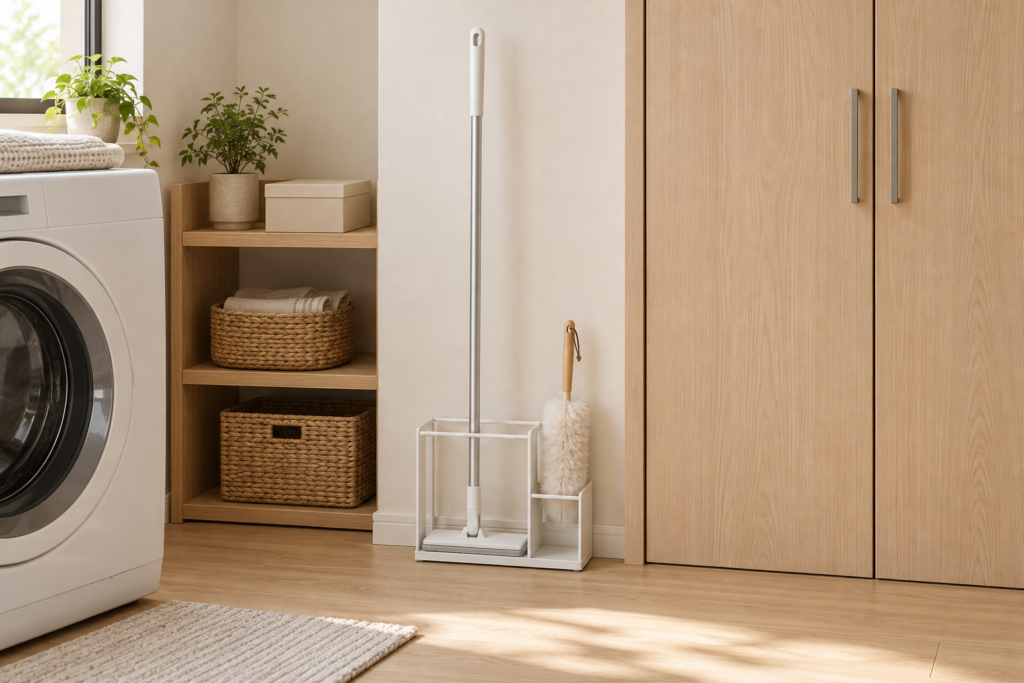
Yamazaki’s Tower Cleaning Tool Organiser illustrates a compartment-based approach to grouping cleaning tools.
Use this English-language manufacturer page as a design reference. It is a regional storefront, not a confirmed U.S. purchasing option.
Before choosing this type of organizer, compare each compartment with your own tools. A holder intended for a flat floor sweeper should not be assumed to fit a string mop, spray mop, or stick vacuum.
A narrow footprint is useful only if the tools fit and remain easy to retrieve.
Plan drying separately from everyday storage
Do not assume a concealed organizer is also a drying station.
After cleaning, follow the tool manufacturer’s instructions for washing, drying, and storage. Where a removable pad or mop head needs to dry, plan a suitable place for that step before returning it to enclosed storage.
Keep the storage base accessible so you can remove dust and clean it as needed.
Cleaning liquids also need their own storage plan. Follow the product labels rather than placing bottles in any remaining gap beside the tools.
Test the movement before buying
Use the actual tools to rehearse the routine in the proposed location:
- Open the door, if there is one.
- Reach the handle without moving another item.
- Lift or slide the tool out.
- Return it to its storage position.
- Close the door and check the surrounding walkway.
Mark the proposed organizer footprint on the floor with paper if that helps. Keep the area clear during the test so the paper does not become a trip hazard.
If the tools already have a stable, accessible home, you may not need another organizer.
Keep supplies nearby without crowding the tools
Store only a manageable quantity of replacement pads, cloths, or roller refills beside everyday tools.
A small existing container can group loose supplies. Avoid filling the space needed to grip a handle or remove a cleaning head.
If you are considering a bathroom cupboard for smaller supplies, our guide to organizing under a small bathroom sink covers pipes, access, and usable storage space.
Choose a place that makes cleaning easier
The best location is not necessarily the smallest gap.
Choose a place where the tool fits, the door closes, and you can take it out without rearranging the room.
Start with one frequently used tool. Once its storage routine works, add the others only if access remains straightforward.
Small spaces. Thoughtful solutions. Inspired by Japan.