A Japanese brand name does not necessarily mean a kitchen tool was made in Japan.
The same is true of Japanese design, Japanese steel, or a Japanese-style knife shape. Each describes something different—and none should replace checking the manufacturing information for the exact product.
This guide shows you what to look for on official product pages, packaging, and seller listings, with three examples of different origin claims.
Research note: The product examples below are based on published official information checked on October 13, 2026. We have not inspected their physical labels or personally tested them. Links are reference links, not affiliate links.
- Separate the claims before you compare products
- Find the exact model first
- Look for an explicit manufacturing statement
- Three examples of different claims
- Check the packaging and product marking
- What if the seller and manufacturer disagree?
- Missing information means unconfirmed
- Origin and authenticity are different questions
- A quick checklist before buying
- How ENISHI Living describes origin
Separate the claims before you compare products
| Wording | What it describes |
|---|---|
| Japanese brand | The brand’s identity or origin |
| Designed in Japan | Where the design is attributed |
| Japanese steel | A claim about the material |
| Japanese-style | A shape, technique, or aesthetic |
| Made in Japan | A claim about product manufacture |
A product can carry more than one of these descriptions. It can also be designed in Japan and manufactured in another country.
Read the complete statement rather than treating the word “Japanese” as a manufacturing guarantee.
Find the exact model first
Start with the model number or product code, not just the brand and product name.
A brand may sell products made in different countries. Similar-looking items may also differ by size, series, color, or market.
Record:
- Brand and product name.
- Model number or product code.
- Size and selected variant.
- The seller’s listing you are considering.
Then match those details with the manufacturer’s product page or an official regional distributor’s information.
A country-of-origin statement about a different model does not settle the question for yours.
Look for an explicit manufacturing statement
On the official page, check sections such as Specifications, Details, Origin, FAQ, or Product Information.
Look for wording that directly addresses manufacture: “Made in Japan,” “Manufactured in China,” or a clearly identified manufacturing-country field.
Keep other information separate. A Japanese company address, design location, or shipping warehouse does not establish where the product was manufactured.
If the page names several countries, check what each country refers to. Do not assume the most prominently displayed one describes the finished product.
Three examples of different claims
An explicit made-in-Japan statement: GLOBAL G-80
The GLOBAL Knives UK product page identifies the G-80 Fluted Santoku as made in Japan.
It also lists an 18 cm blade and CROMOVA 18 stainless steel. Those specifications help identify the model; the explicit manufacturing statement is the relevant evidence for the origin claim.
This example establishes what the official distributor says about the G-80. It is not a substitute for matching the model on a seller’s listing or checking the item you receive.
Official reference: GLOBAL G-80 Fluted Santoku
Japanese design, Chinese manufacture: Yamazaki Tower spice rack
Yamazaki’s official page for the small Tower magnetic spice rack lists:
- Product numbers: 5128 (white), 5129 (black).
- Origin: designed in Japan, made in China.
Both statements can be true. Describing this rack as Japanese-designed is consistent with the listing; describing it as made in Japan would not be.
For dimensions and installation limitations, see our Yamazaki kitchen storage comparison.
Official reference: Tower Spice Rack for Magnet Panel Organiser, Small
Japanese steel, Chinese manufacture: Okami Classic
Okami’s Classic 8-Inch Chef Knife page describes AUS-8 Japanese stainless steel and identifies manufacture in Yangjiang, China.
The steel-origin claim and the knife’s manufacturing location are separate information. Japanese steel does not make the finished knife a made-in-Japan product.
Likewise, “gyuto” identifies a knife style. It does not establish a country of manufacture.
Our gyuto and santoku guide explains how to compare shape, dimensions, and storage requirements.
Official reference: Okami Classic 8-Inch Chef Knife
Check the packaging and product marking
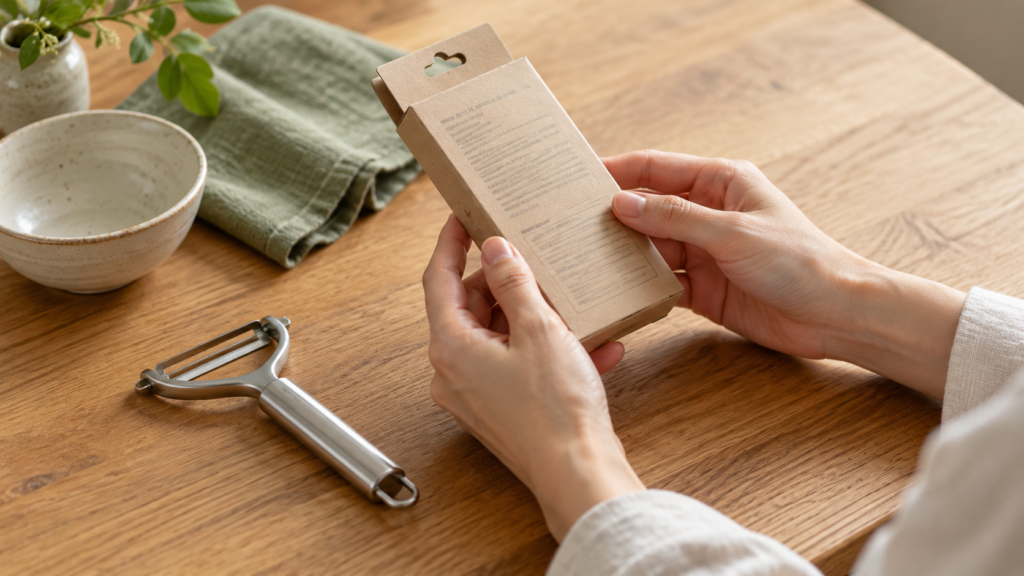
If you already own the item, inspect its packaging, label, underside, or other manufacturer markings where accessible.
Look for an explicit manufacturing-country statement and compare the model number with the official information.
Two Japanese terms you may encounter are:
- 日本製: made in Japan.
- 原産国: country of origin; read the country stated beside it.
Japanese writing alone is not proof of Japanese manufacture. Packaging can be written for a particular market regardless of where the product was made.
A barcode prefix, flag, Japanese place name, or importer address is also not a substitute for an explicit origin statement.
What if the seller and manufacturer disagree?
First, check whether you are looking at the same model and variant.
If they match but the origin information conflicts, ask for clarification before buying. You can send this question:
“Could you confirm the manufacturing country for model [model number], variant [size/color]? Your listing states [claim], while the official page states [different claim]. Please clarify which information applies to the item you will supply.”
If useful, request a photograph of the origin label on the actual stock.
Do not resolve a disagreement by choosing whichever description you prefer. Record the uncertainty until you receive an answer that clearly applies to the product.
Missing information means unconfirmed
If you cannot find an explicit manufacturing statement, the appropriate conclusion is “manufacturing country unconfirmed.”
It does not prove the product was made outside Japan, and it does not justify assuming it was made there.
If Japanese manufacture is essential to your purchase, wait for confirmation or choose a model with clearer documentation.
If it is not essential, you can still compare the product’s fit, materials, care instructions, and seller support without making an unsupported origin claim.
Origin and authenticity are different questions
A manufacturing-country statement does not, by itself, prove that a particular seller’s item is genuine.
Check the manufacturer’s information about authorized sellers where available. Match the model, packaging, and product details, and clarify inconsistencies.
Equally, manufacture outside Japan does not automatically make an item counterfeit or unsuitable. Evaluate the evidence for the exact product and seller.
A quick checklist before buying
- Identify the exact model and variant.
- Find an explicit manufacturing-country statement.
- Separate brand, design, material, and manufacturing information.
- Compare the official information with the seller’s listing.
- Ask about conflicting or missing details.
- Recheck the label when the item arrives.
The reference pages in this guide illustrate how to read origin claims. They do not confirm current US availability, shipping eligibility, or every seller’s stock.
How ENISHI Living describes origin
We aim to state what the available evidence supports.
When an official source identifies Japanese design and manufacture elsewhere, we distinguish those facts. When a source explicitly states made in Japan, we attribute that statement to the exact model. When the information is unclear, we say so.
Country of manufacture is one part of product selection. Dimensions, installation, usability, and care still matter—especially in a small kitchen.
The goal is a more informed choice, not a conclusion based on a brand name or photograph.
Small spaces. Thoughtful solutions. Inspired by Japan.