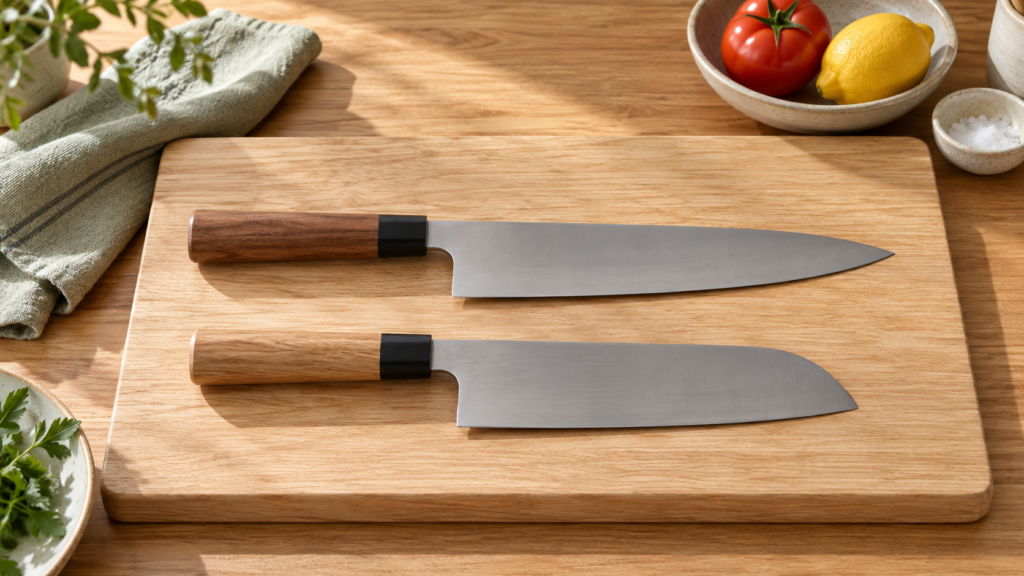
A small kitchen does not automatically need a santoku—or rule out a gyuto.
Both are versatile knife styles. The more useful question is which particular knife fits your cutting board, everyday ingredients, preferred cutting motion, and storage space.
This guide explains the differences and uses two published product examples to show why blade length alone is not enough.
Research note: We have not personally tested the knives mentioned. This guide uses manufacturer information and published specifications checked on October 13, 2026. Links are reference links, not affiliate links. The examples are not a performance ranking.
The short answer
Consider a santoku if you prefer a relatively flat cutting edge and straightforward slicing or chopping.
Consider a gyuto if you prefer a pointed tip and a curved edge suited to your cutting motion, or regularly want more cutting length.
These are starting points, not fixed rules. Profiles and dimensions vary between models. A shorter gyuto may suit your space better than a longer santoku.
Compare the shape before the label
| Feature | General difference |
|---|---|
| Edge profile | Santoku: flatter; gyuto: more curved |
| Tip | Santoku: less pointed; gyuto: pointed |
| Cutting motion | Santoku: straight cuts; gyuto: slicing and gentle rocking |
| Fit in your kitchen | Check the exact model’s dimensions |
Shun’s manufacturer guide describes santoku knives as generally flatter-edged and chef’s knives as generally more curved. Both can handle everyday preparation.
Do not assume every gyuto rocks the same way or every santoku has an entirely straight edge. Look at the actual blade profile.
Reference: Shun’s santoku and chef’s knife guide
Start with your cutting board
The size of your kitchen matters less than the usable space where you prepare food.
Check that your board sits securely and leaves room for your hands, ingredients, and knife movement. A board crowded with food can be inconvenient even with a short knife.
Ask yourself:
- Can I work without bumping a wall, sink, or nearby object?
- Do ingredients crowd the cutting area?
- Does my usual cutting motion feel cramped?
- Could rearranging the preparation area help more than buying a knife?
There is no single board-to-blade ratio that guarantees a comfortable setup. Assess your actual workspace.
Think about the food you prepare
For everyday vegetables and boneless ingredients, either style may meet your needs.
A flatter-edged santoku may appeal if you prefer straight cutting motions and manageable portions. A gyuto may appeal if you often make longer slicing cuts or prefer its tip and curved profile.
Extra blade length can be useful, but only if you can control it comfortably.
If your existing knife already handles your meals well, a different knife shape is not an essential upgrade.
Blade length is not storage length
A listing’s blade measurement excludes the handle. Check overall length before buying a drawer organizer, guard, or storage case.
Two examples illustrate the difference.
Santoku example: TOJIRO FLASH 180mm
TOJIRO’s official listing specifies:
- Model: FF-SA180
- Blade length: 180 mm, approximately 7.1 inches
- Total length: 315 mm, approximately 12.4 inches
- Weight: 240 g, approximately 8.5 oz
- Core steel: VG10
- Edge: double bevel
This is a dimension example, not a claim that it is the best compact knife. Its 180 mm blade does not mean it needs only 180 mm of drawer space.
Official specifications: TOJIRO FLASH Santoku 180mm
Gyuto example: Okami Classic 8-Inch Chef Knife
Okami’s official product page lists:
- Product: Classic Chef Knife, 8-Inch
- Profile: gyuto
- Blade length: 203 mm, approximately 8 inches
- Overall length: 330 mm, approximately 13 inches
- Weight: approximately 213 g, or 7.5 oz
- Steel: AUS-8 stainless steel
- Included items: blade guard and care card
- Manufacture: Yangjiang, China, using Japanese steel, according to the brand
The longer-bladed Okami example is listed as lighter than the TOJIRO santoku above. That is a useful reminder that knife shape alone does not determine weight.
These knives differ in construction, materials, and handle design, so their specifications do not establish which performs better.
Official specifications: Okami Classic 8-Inch Chef Knife
Check storage before ordering
Measure the storage location using overall length, blade height, and the space occupied by any guard or organizer.
A protected drawer arrangement may keep the counter clear. A knife block uses counter space. A wall-mounted solution needs secure installation and a suitable location.
Choose storage that protects the edge and prevents accidental contact. Keep knives inaccessible to children and avoid leaving them loose among other utensils.
A knife that fits inside a drawer is not necessarily convenient to retrieve from it.
Care depends on the model, not the shape
“Gyuto” and “santoku” describe knife styles. They do not tell you whether the steel resists corrosion, whether the handle tolerates soaking, or which sharpening method is appropriate.
Read the exact model’s instructions before buying.
Okami specifies hand washing and immediate drying for the Classic, and advises against dishwasher use. Shun also provides model-care guidance covering cleaning, cutting surfaces, and appropriate use.
Do not treat an all-purpose preparation knife as a cleaver for bones or frozen food. Follow the manufacturer’s instructions and use a suitable tool for the task.
Reference: Shun knife use and care
Japanese-style does not necessarily mean made in Japan
A Japanese knife shape, Japanese steel, and Japanese manufacture are different claims.
Okami explicitly describes the featured Classic as manufactured in China from Japanese steel. It should not be presented as a made-in-Japan knife.
If manufacturing country matters to you, look for an explicit statement about the exact model. A brand name, blade shape, or steel name is not enough.
Which should you choose?
Choose a santoku when its actual dimensions, edge profile, and handling suit your everyday preparation.
Choose a gyuto when its actual dimensions, tip, and cutting profile suit the way you work.
Before ordering either, check:
- Blade length and overall length.
- Weight and handle shape.
- Comfortable movement on your board.
- Protected storage.
- Care and sharpening requirements.
- Manufacturing information and the seller’s return terms.
If possible, handle the knife before choosing. Published measurements cannot tell you exactly how a grip will feel.
You do not need both styles simply because they appear in a comparison. Start with the knife that fits your routine—or keep the one that already works.
For more ways to keep your preparation area clear, see our no-drill kitchen storage guide.
Small spaces. Thoughtful solutions. Inspired by Japan.