Pot lids can be awkward to store even when the pots themselves fit neatly. A large knob interrupts a stack, a glass lid slides between pans, or the lid you need sits underneath everything else.
Before buying an organizer, check the lids you actually use and the space needed to remove them.
The goal is not to stand every lid upright. It is to make your regular cookware easy to put away and retrieve.
Research note: This is a research-based guide, not a hands-on product test. Manufacturer information was checked on October 20, 2026. The product example illustrates a storage method rather than a performance ranking. Links are reference links, not affiliate links.
Separate everyday lids from occasional ones
Start by matching each lid to the cookware it fits.
Check whether some lids serve more than one pan and whether you still use all the cookware in the cupboard. Keep frequently used lids in the easiest positions; occasional items can occupy less convenient storage.
You do not need to buy an organizer large enough for unused cookware simply because it is already there.
Measure more than the diameter
A lid’s diameter is only one part of its storage size.
| Measurement | Why it matters |
|---|---|
| Outside diameter | Determines the overall space needed |
| Handle or knob projection | Affects divider spacing |
| Stored height | Includes the organizer base and lid position |
| Cabinet opening | May be narrower than the interior |
| Removal space | Lets you lift a lid out without moving others |
Measure the widest edge of the lid and its overall depth, including the handle.
For upright storage, test the height with the lid resting in its intended position. A rack that fits beneath a shelf may still leave too little room for the lid above it.
In a drawer, check the closed clearance beneath the cabinet frame or drawer above. Do not force the drawer shut to test a tight fit.
Compare upright and flat storage
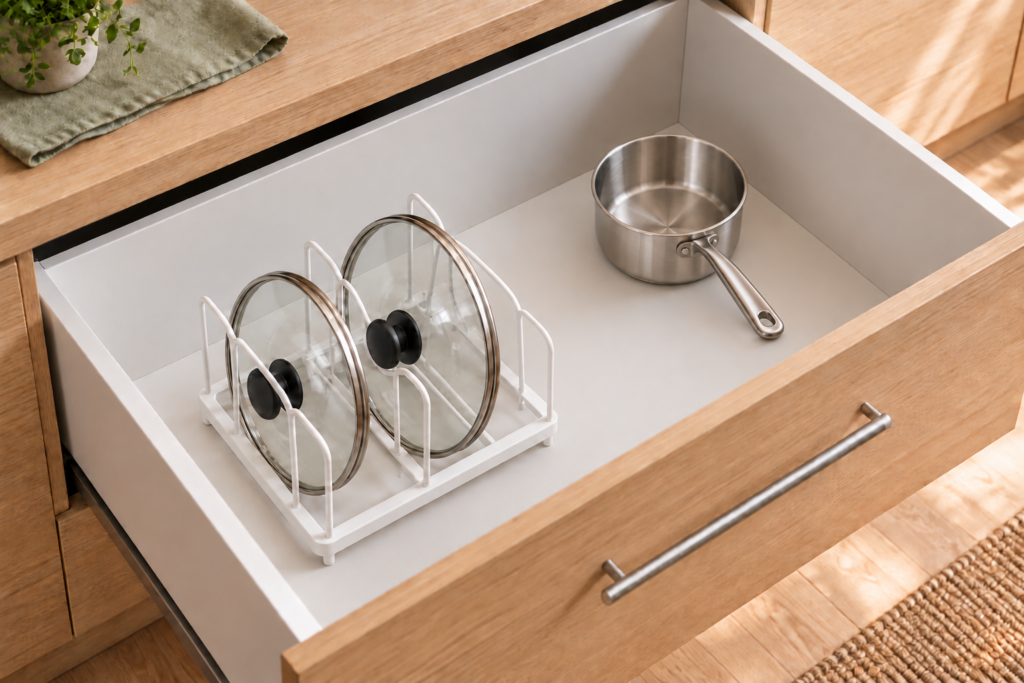
Upright dividers
Individual slots can make lids easier to see and select.
Check whether the dividers support the lid securely and leave room for its handle. A deep domed lid may need more space than a flat one of the same diameter.
When to skip it: The cupboard is too low, the lid sits unstably, or you cannot lift it out without hitting the shelf.
Flat storage
A small number of lids may work on a shelf without a separate rack.
Avoid unstable stacks, and follow your cookware manufacturer’s guidance about contact between surfaces. Reaching the bottom lid should not require lifting a heavy pile.
When to skip it: You repeatedly move several lids to reach the one you need, or handles prevent the stack from sitting securely.
Keeping a lid with its pot
If a pot has a dedicated space and the lid can remain in its normal position, storing them together may be the simplest option.
It uses more height, but avoids a separate search for the matching lid.
When to skip it: The arrangement prevents practical nesting or makes the cookware difficult to remove.
Door-mounted holders need extra clearance
An apparently empty cupboard door may face directly into shelves, pans, or plumbing when closed.
Check the combined projection of the holder and lid, including the knob. Confirm the door can close normally and that stored items do not strike the cabinet contents.
For adhesive, screw-mounted, or over-door products, follow the exact mounting requirements. A no-drill design is not automatically compatible with every surface.
When to skip it: You cannot confirm the fixing method or load capacity, or the loaded holder obstructs the door.
In a rental, check installation restrictions before attaching anything.
An adjustable example from Yamazaki
Yamazaki’s US Tower Adjustable Pot Lid Organizer has repositionable dividers and an expandable base.
The manufacturer’s FAQ says lids and pans between 7 and 12 inches work well with the organizer. That size range does not replace checking handle depth, cupboard height, and the complete loaded footprint.
Adjustable spacing is useful when lids have different profiles. It also means that allowing more space for one bulky lid reduces the room available for other items.
When to skip it: Your storage area is smaller than the organizer’s minimum footprint, your lids fall outside the stated compatibility, or the loaded arrangement cannot be removed comfortably.
Confirm current dimensions, care instructions, and availability before buying. Do not use specifications from a similar regional model without checking.
Test the whole retrieval movement
Place cool, dry lids in the proposed position and try your normal actions.
Can you:
- Remove the largest lid without shifting the organizer?
- Grip a handle without catching the neighboring lid?
- Return one lid without rearranging the others?
- Open and close the drawer or cupboard normally?
- Reach cookware stored beside or behind the rack?
If the organizer slides or tips during normal use, reassess the setup and follow the manufacturer’s installation instructions.
A rack that holds every lid is not necessarily the arrangement that works best.
Keep cooking-time lid rests separate
A cupboard organizer is for storage unless its instructions specifically allow another use.
For a hot lid during cooking, use a suitable heat-resistant rest or surface and follow the relevant product instructions. Do not assume a storage rack can safely hold hot cookware.
Allow cookware to cool, then clean and dry it before storage according to its care instructions.
If drying space is the problem, our guide to dish racks for small kitchens can help you assess the sink area.
Start with the lids you use most
Try improving access for two or three everyday lids before reorganizing the entire cupboard.
A smaller group, a different shelf position, or keeping one lid with its pot may solve the problem without another product.
Choose storage that supports your actual lids and leaves enough room to take them out—not just enough room to put them in.
Small spaces. Thoughtful solutions. Inspired by Japan.