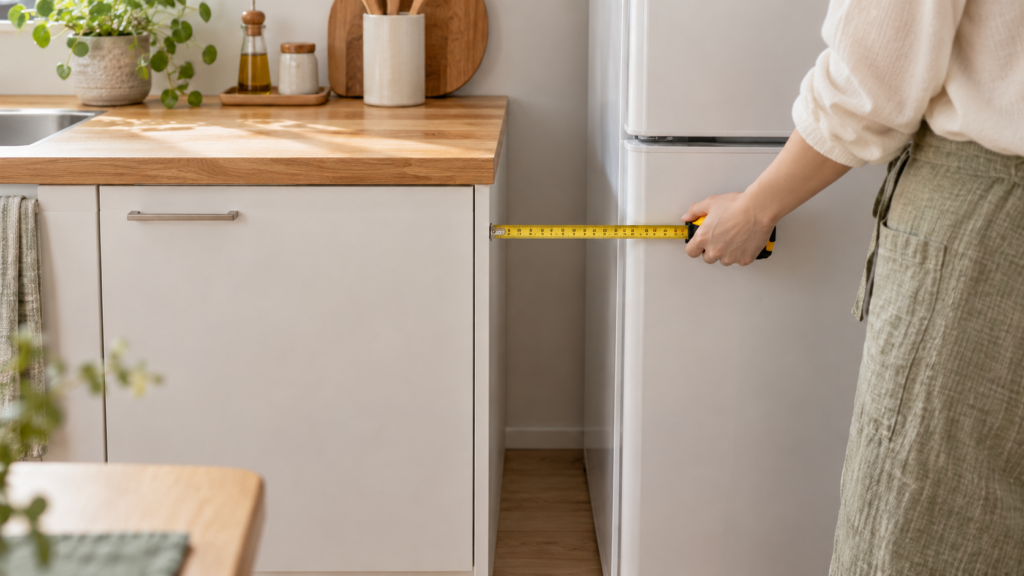
A narrow gap beside a refrigerator or cabinet can look like wasted space. Before filling it, check two things: its exact dimensions and whether that space needs to remain clear.
A five-inch gap measures 12.7 cm. That matters when shopping for slim storage: a cart listed at 13 cm wide is wider than the opening, even if a photograph makes it look like a perfect fit.
This guide explains how to measure a narrow kitchen gap, assess possible storage, and recognize when leaving it empty is the better choice.
- The short answer: measure before choosing storage
- Measure the gap at several points
- Check whether the gap is actually available
- Why a “slim” cart may still be too wide
- Option A: consider a narrower removable organizer
- Option B: assess flat-item storage
- Option C: leave the gap empty
- Before ordering a narrow organizer
- A useful gap is one you can access
The short answer: measure before choosing storage
You may be able to use a five-inch gap for a narrower removable organizer or an appropriate flat item. But width alone does not establish whether either option will work.
A usable storage space also needs enough depth, height, access, and clearance. If the gap serves an appliance’s ventilation or door movement, it may not be available for storage at all.
| Check | Why it matters |
|---|---|
| Narrowest width | Determines whether the item fits |
| Usable depth | Prevents unwanted projection |
| Height | Allows room to reach stored items |
| Pull-out route | Makes storage accessible |
| Appliance clearance | Identifies space that must stay clear |
Measure the gap at several points
Measure the width at the front, middle, and back where you can safely reach. Check near the floor as well as higher up.
Baseboards, cabinet trim, and uneven surfaces can reduce the usable opening. Use the smallest relevant measurement, rather than the widest part you can find.
Then record:
- The depth available without interfering with cables, pipes, or other obstructions.
- The height available and room needed above stored items.
- The route for inserting and removing the organizer.
- Any restrictions in the nearby appliance’s installation instructions.
Do not move a heavy appliance simply to take a measurement. If you cannot inspect the space safely, treat its suitability as unconfirmed.
Check whether the gap is actually available
A gap next to a freestanding cabinet is different from a gap beside a refrigerator, oven, or dishwasher.
For an appliance, consult the installation instructions for the exact model. Look for required clearances, ventilation areas, and access needed for servicing or door movement.
There is no single clearance measurement that applies to every appliance.
Do not assume a gap is spare storage space because no vent is visible. If the instructions are unclear, confirm with the manufacturer before placing anything there.
Why a “slim” cart may still be too wide
Yamazaki’s Tower Three-Tier Rolling Storage Cart provides a useful example of why exact measurements matter.
Its official listing specifies:
- Model numbers: 1804 (white), 1805 (black)
- Overall dimensions, W × D × H: 13 × 48 × 80.5 cm, including casters
- Approximate dimensions: 5.12 × 18.9 × 31.7 inches
- Shelf load limits: top 1 kg; middle 10 kg; bottom 10 kg
- Total stated load limit: 21 kg
- Assembly required
- Origin: designed in Japan; made in Taiwan
A true five-inch opening is 12.7 cm wide—3 mm narrower than this cart. It is not a suitable fit.
A gap measuring exactly 13 cm also does not establish that the cart will move comfortably. Check the installation instructions and allow for the actual surfaces and movement involved; this guide does not prescribe an unsupported clearance margin.
Official specifications: Tower Three-Tier Rolling Storage Cart
Research note: These specifications were checked on October 12, 2026. We have not personally tested this cart or verified current US availability. The link is an official specification reference, not an affiliate link.
Option A: consider a narrower removable organizer
If the space is available for storage, search for an organizer with an overall width smaller than the narrowest usable opening.
Check the entire product, including wheels, handles, fittings, and any protruding parts—not just the shelf width.
A removable organizer may be useful when:
- It can move without rubbing the surrounding surfaces.
- Its depth fits the available space.
- You can retrieve it without blocking essential access.
- Your intended contents fit its shelves and load limits.
There is no verified narrower product recommendation in this guide. Compare exact specifications rather than treating “five-inch cart” or “slim storage” as a fit guarantee.
Option B: assess flat-item storage
A baking tray or cutting board may be narrow enough to fit, but simply sliding it into a gap does not necessarily make useful storage.
Only consider this approach where the space is dry, accessible, and not needed for appliance clearance.
Check whether the item can remain supported, be removed comfortably, and avoid rubbing against surrounding finishes. Do not put sharp, unstable, or difficult-to-retrieve objects into a narrow opening.
If you need an additional holder to make the arrangement work, include that holder in your measurements.
A cabinet divider may be more convenient if it keeps the same items cleaner and easier to reach.
Option C: leave the gap empty
Leaving a gap clear is a sensible outcome when:
- It is required for appliance operation or access.
- No organizer fits with room to move.
- Stored items would be difficult to retrieve.
- The arrangement makes cleaning harder.
- It solves no problem beyond making an empty space look occupied.
You do not need to use every available inch.
If floor-level storage is unsuitable, look elsewhere: rearrange a cabinet, reduce duplicate items, or assess compatible vertical storage.
Our guide to no-drill kitchen storage for renters compares magnetic, under-shelf, and freestanding approaches.
Before ordering a narrow organizer
Keep your measurements beside the seller’s specifications and ask:
- Is the stated width the full external width?
- Does the depth include the handle?
- Is the height measured with wheels attached?
- Will my bottles or other items fit inside?
- Can I remove the organizer and clean behind it?
- Does it preserve the appliance’s required clearances?
For regional products, match model numbers and specifications. A similar name or photograph does not prove that two carts have identical dimensions.
For other Yamazaki storage examples, see our small-space kitchen storage comparison.
A useful gap is one you can access
The aim is storage that makes daily life easier.
Measure accurately, preserve required clearances, and choose something you can remove and clean. If those conditions cannot be met, use another storage location.
A five-inch gap can prompt a useful improvement—but it does not need to become storage to earn its place in your kitchen.
Small spaces. Thoughtful solutions. Inspired by Japan.