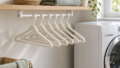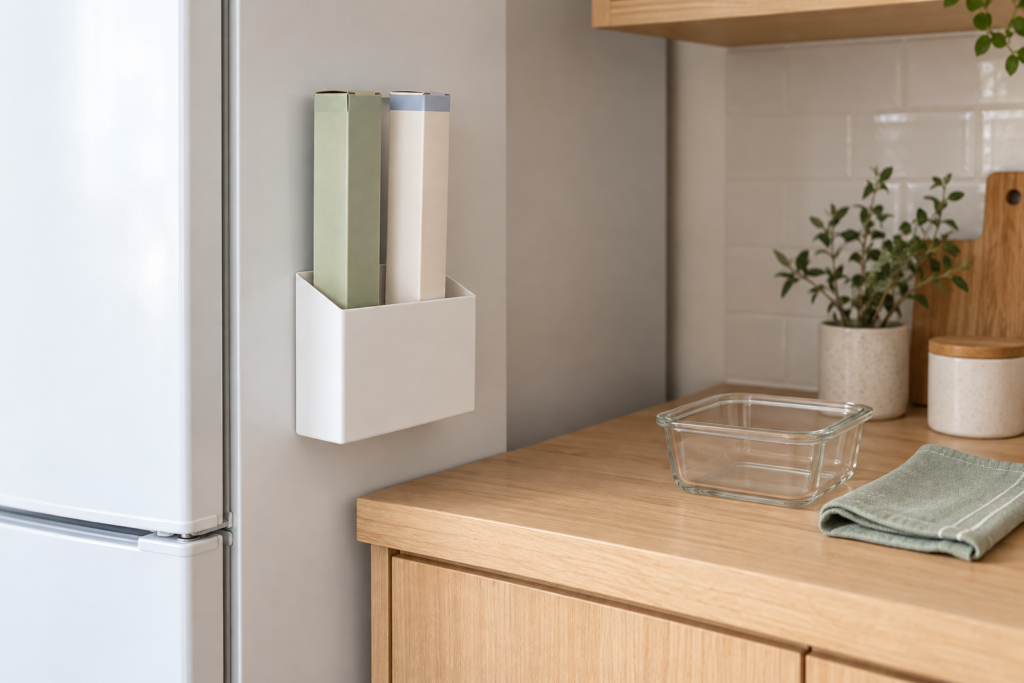
A wrap box fits upright in a holder—but there is not enough room above it to lift it out.
A foil box fits in a drawer—but catches beneath the cabinet frame when the lid is left open.
In a small kitchen, storage needs to accommodate the complete box and the movement required to use it.
Start with the products you already buy. Measure their packaging before choosing a new organizer.
Research note: We have not personally tested the holder mentioned below. This guide combines practical planning suggestions with manufacturer information checked on October 29, 2026. The product is a specification example, not a performance ranking. External links are reference links, not affiliate links.
Keep everyday boxes separate from refills
Gather your plastic wrap, aluminum foil, parchment paper, and any other boxed rolls.
Separate the open boxes you currently use from unopened replacements.
The everyday storage area does not need to hold every spare box. Moving refills elsewhere may create enough space without another organizer.
If you have several open boxes serving the same purpose, consider using those before buying more.
Measure the box, not the roll label
The width printed on a roll describes the material inside. It does not give the complete packaging dimensions.
Measure the outside of each box, including projecting ends or closures.
| What to check | Why it matters |
|---|---|
| Overall box length | Whether it fits horizontally or clears a shelf |
| Box width and thickness | Whether it fits the holder’s compartment |
| Full-box weight | Whether it suits the holder’s load limit |
| Removal space | Whether you can lift or slide the box out |
| Space to open and cut | Whether you have a practical place to use it |
Large refill packs or longer rolls may come in thicker boxes even when the film width is familiar.
For upright storage, the box’s length becomes its stored height. Add the space needed to lift it clear of the holder.
Compare three storage methods
Lay boxes flat in a drawer
A shallow drawer can keep boxes visible and close to the preparation area.
Try placing them in one layer before adding dividers. Check the drawer’s usable length and closing height.
Keep box lids closed when returning them, and make sure no loose packaging catches beneath the cabinet frame.
When to skip: The drawer is too short, boxes become buried beneath utensils, or you must rearrange several items to remove one.
Store boxes upright
An upright organizer can group boxes in a narrow area, provided their shape and size suit its compartments.
Check the height with the boxes loaded. A short holder can still require a tall storage space.
Leave enough exposed box to grip it comfortably, without relying on a loose cardboard flap.
When to skip: The boxes lean out, are squeezed into the compartments, or cannot be lifted out beneath the shelf above.
Attach a magnetic holder
A magnetic holder can move suitable boxes onto a compatible surface.
Check that the exact mounting area supports magnets and meets the holder’s instructions. A refrigerator’s appearance alone does not establish compatibility.
Check the appliance manufacturer’s guidance before placing accessories on it. Keep vents and required clearances unobstructed.
When to skip: The mounting area is unsuitable, the holder obstructs a door or passage, or the loaded boxes exceed the stated limits.
Product example: Tosca Magnetic Side Rack
Yamazaki’s Tosca Magnetic Side Rack combines an upper compartment for boxed wraps with a paper towel rod and additional hooks.
| Item | Manufacturer’s published information |
|---|---|
| Overall size | W32 × D9.5 × H20 cm |
| Weight | 0.99 kg |
| Load capacity | 1.5 kg |
| Load limit per hook | 0.25 kg |
| Main materials | Steel, magnet, wood, and silicone |
| Included hooks | Two |
| Origin | Designed in Japan, made in China |
The linked page is Yamazaki Home’s European storefront and is written in English. Use it as a design and specification reference; it does not establish U.S. availability.
This rack is larger than a wrap-only holder. Check whether you need its additional paper towel rod and hooks before allocating space for it.
The overall dimensions do not describe the usable space inside the upper compartment. Confirm that your actual boxes fit, and allow enough room above to lift them out.
Include all stored items when checking the load limit. Arrange hooks and hanging items so they do not obstruct doors or the working area.
Check the loaded position near doors
A holder that fits beside the refrigerator may still interfere with opening it.
With the proposed holder and box sizes in mind, check:
- The refrigerator door’s full opening movement.
- Nearby cabinet doors and drawers.
- The space needed to grip and remove a box.
- Whether boxes project into the working or walking area.
If you are considering the inside of a cupboard door, check shelf and hinge clearance as well as the attachment method.
Our guide to no-drill kitchen storage for renters covers other mounting conditions to consider.
Plan where you will actually use the box
A storage holder and a dispenser are different products.
Do not assume a holder is designed for pulling and cutting material while the box remains inside it.
For a simple storage holder, take the box out and use it according to its instructions, with enough room to open the lid and operate the cutter.
If you want a dispenser or replacement case, check compatibility with the roll’s width, diameter, core, and material before transferring it.
Keep the original packaging information where needed for use and replacement.
Test one box before organizing the whole group
Choose the box you use most often and rehearse the routine:
- Reach it without moving another item.
- Lift or slide it out completely.
- Take it to the place where you normally use it.
- Close the box and return it.
- Open nearby doors and drawers fully.
A good arrangement should work when every box is back in place, not only when one is being used.
Buy for the remaining problem
If your existing drawer keeps the boxes visible and accessible, you may not need a new holder.
If one long box is the problem, give that box a separate position rather than replacing the whole storage system.
Start with the packaging you already own and the movement you repeat each day. Choose an organizer only when its dimensions and mounting conditions solve a specific difficulty.
Small spaces. Thoughtful solutions. Inspired by Japan.