The container you need is at the bottom of a stack. Its lid is somewhere else.
In a small kitchen, food-container storage can become awkward even when everything technically fits.
The goal is to make a matching container and lid easy to find, remove, and put back.
This guide focuses on storing empty containers. Refrigerating food, reheating, and transporting meals require separate checks against the instructions for each product.
Research note: We have not personally tested the containers mentioned below. This guide combines practical planning suggestions with manufacturer information checked on October 25, 2026. The product is a specification example, not a performance ranking. External links are reference links, not affiliate links.
- Match the containers and lids first
- Choose between paired storage and nesting
- Give separated lids a defined place
- Measure the arrangement you will actually use
- Product example: checking sizes within a small set
- Leave room for washing and drying
- Test the system with your usual container
- Buy only for a specific remaining problem
Match the containers and lids first
Before buying bins or dividers, take out your empty containers and find the correct lid for each one.
Similar-looking lids are not necessarily interchangeable. Check the fit without forcing them.
Group the matching sets, then separate:
- Containers you use regularly.
- Larger or unusual sizes used occasionally.
- Unmatched parts that need identifying.
- Damaged pieces that need checking against the manufacturer’s care instructions.
Avoid buying replacements simply because the correct lid is difficult to find.
If you want to keep an unmatched container for another purpose, give it a specific job rather than returning it to the everyday food-container group.
Choose between paired storage and nesting
Store each container with its lid
Keeping matching pieces together can make selection straightforward.
It may work well for a small collection of frequently used containers, provided the products are clean, dry, and stored according to their instructions.
The trade-off is space. Containers stored with lids generally occupy more room than compatible empty bodies nested together.
When to skip: The resulting stack is unstable, too tall, or difficult to separate.
Nest compatible empty containers
Nesting means placing a smaller empty container inside a larger one.
It can reduce storage space when the shapes are designed to fit together. However, identical containers do not necessarily nest, and different sizes do not automatically fit.
Follow the manufacturer’s guidance. Do not force glass containers together or wedge incompatible pieces into a tight stack.
When to skip: Removing one container requires lifting a heavy group, the pieces jam together, or the container you use most is always buried.
Use a combination
You do not need one method for the entire collection.
Keep a few everyday sets together and nest compatible occasional-use containers separately.
Choose the arrangement that makes your usual routine easier.
Give separated lids a defined place
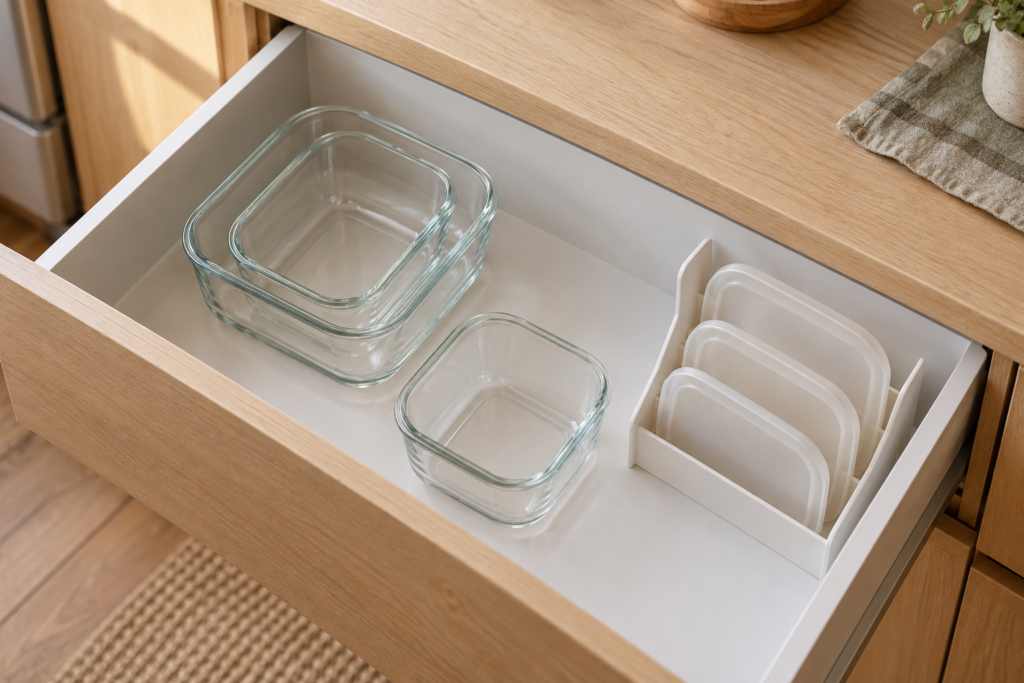
If you nest the container bodies, the lids need their own storage space.
A small existing box may be enough. Group lids by the containers they fit, rather than sorting only by appearance.
Upright storage can make lids easier to see, but it needs suitable support and enough height. Flat storage may work better in a shallow drawer.
Before adding dividers, test whether you can remove one lid without lifting the whole group.
When to skip an organizer: Its slots do not suit your lid thickness, its footprint crowds the containers, or it creates more compartments than you need.
Measure the arrangement you will actually use
Capacity describes how much a container holds. It does not tell you how much cupboard space it needs.
Check the outside dimensions, including rims, clips, and handles.
| What to measure | Why it matters |
|---|---|
| Outside width and depth | Whether the container fits the storage area |
| Height with the lid fitted | Whether paired storage clears the drawer opening |
| Height of the intended stack | Whether the complete arrangement fits |
| Upright lid height | Whether lids catch beneath the cabinet frame |
| Removal space | Whether you can grip and lift individual pieces |
Measure the actual stack rather than estimating from one container’s height.
For a cupboard, check shelf supports and hinges. For a drawer, check the usable closing height beneath the cabinet frame.
Product example: checking sizes within a small set
HARIO’s Heatproof Glass Container Square, 3pcs set provides an example of published specifications for two container sizes.
| Item | Manufacturer’s published information |
|---|---|
| Model | KST-2012-OW |
| Small size | 111 × 107 × 47 mm |
| Medium size | 143 × 139 × 62 mm |
| Small full capacity | 250 mL |
| Medium full capacity | 600 mL |
| Container material | Heatproof glass |
| Lid material | Polypropylene |
| Listed origin | Made in Japan |
The linked HARIO Europe page displayed a discontinued notice when checked. It is an English-language specification reference, not a confirmed U.S. purchasing option.
The individual measurements do not establish the height of a nested or stacked arrangement. Check that separately before planning a drawer around the set.
Leave room for washing and drying
Storage planning also needs to accommodate the return journey from the sink.
Follow each product’s cleaning and drying instructions before putting it away. Do not turn the container cupboard into an overflow area for pieces that still need attention.
If your drying area regularly fills with containers and lids, review how many you use at once before buying a larger storage organizer.
Our guide to choosing a dish rack for a small kitchen covers drying-space layout and access.
Test the system with your usual container
Choose the container you reach for most often.
Try this short routine:
- Find its matching lid.
- Remove both without rearranging several other items.
- Return the empty, clean, dry pieces to their places.
- Close the drawer or cupboard fully.
If the system works only when several containers are elsewhere, test it again when the full collection is back.
You may need fewer items in the everyday section, a shorter stack, or a different lid position.
Buy only for a specific remaining problem
Before buying another set, identify what is missing.
Do you regularly run out of one useful size? Is a lid genuinely missing? Can you obtain a compatible replacement part for the exact model?
Adding a large mixed set can create more shapes and lids to manage.
Start by making the containers you already use easy to find. Add another item only when it solves a clear need and has a realistic place to live.
Small spaces. Thoughtful solutions. Inspired by Japan.