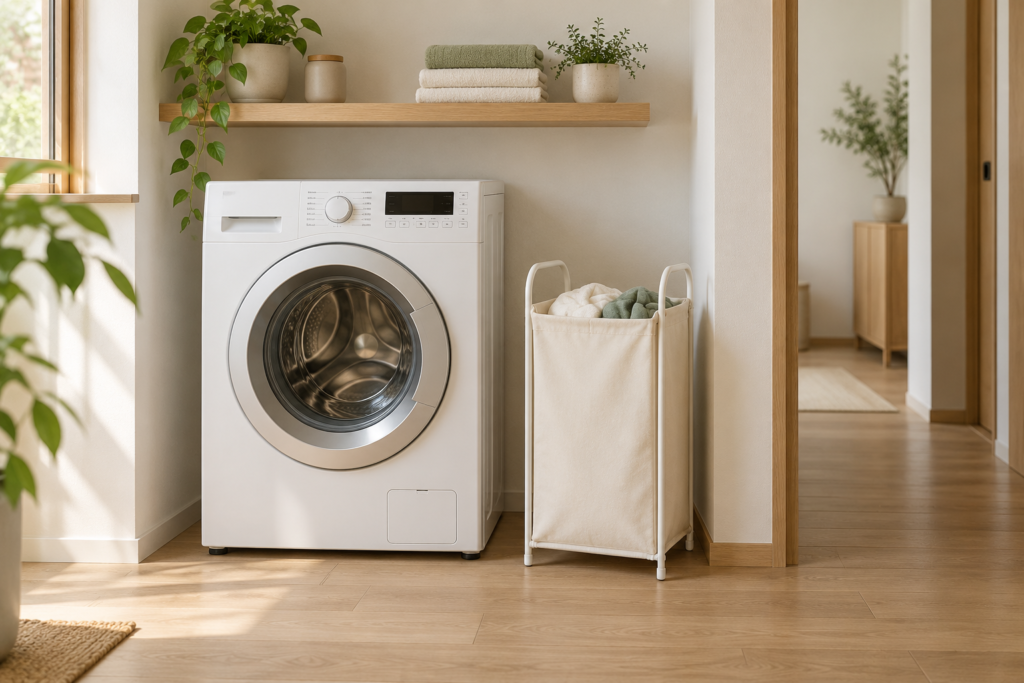
A laundry basket can fit neatly beside a washing machine and still be awkward to use. The handles may catch on a doorway, the basket may block an appliance door, or the folded frame may have nowhere to go.
For a small home, consider three things together: where laundry collects, how you move it, and where the empty basket stays.
Research note: This is a research-based buying guide, not a hands-on product test. Manufacturer information was checked on October 18, 2026. The product example illustrates a design choice rather than a performance ranking. Links are reference links, not affiliate links.
Start with the job you need it to do
Do you need a hamper for collecting dirty clothes, a basket for carrying laundry, or one container that does both?
A tall hamper may work beside a wardrobe but be inconvenient for unloading into a washer. A low, open basket may be easy to reach into but occupy more floor space.
If you use shared laundry facilities, the carrying journey may matter more than how neatly the basket fits at home.
Before comparing products, write one sentence describing the problem:
“I need to carry laundry from the bedroom to a shared laundry room.”
Or:
“I need a basket that can be put away after hanging the washing.”
That makes it easier to avoid buying extra capacity or features you will not use.
Measure the footprint while it is in use
Measure the space with nearby doors and drawers open—not only when everything is closed.
Check:
- The basket’s widest point, including handles and frame.
- Clearance for the washer and dryer doors.
- Space to stand, bend, and load the machine.
- Access to drawers, cupboards, and the room’s doorway.
- Any appliance clearances required by the manufacturer.
An empty corner is not usable storage if filling it prevents a door from opening.
For a folding design, use its fully open dimensions. A product’s slim folded profile does not describe the space it occupies while holding laundry.
Compare the main designs
| Design | Potential advantage | Main tradeoff |
|---|---|---|
| Rigid basket | Keeps its shape while loading | Needs storage space when empty |
| Fabric hamper | Can suit a bedroom collection point | Cleaning and carrying depend on the construction |
| Folding basket | Can reduce storage depth when empty | Needs room to open and somewhere to store the folded shape |
| Rolling basket | Can reduce carrying on a suitable floor | Wheels do not solve stairs or every threshold |
These are design considerations, not guarantees. Check the exact product’s instructions, dimensions, and load limit.
When to skip a rolling design: Your route includes stairs, tight turns, or thresholds that would require lifting it repeatedly.
When to skip a folding design: You keep it full most of the time and have no reason or space to fold it.
Test the carrying route
A basket that fits beside the washer may be too wide to carry comfortably through your home.
Walk the route with an existing basket or a lightweight mock-up of the proposed size. Keep your view clear and do not test with an unnecessarily heavy load.
Consider:
- Can you grip it comfortably?
- Do you need both hands, leaving no hand free for doors?
- Does it bump into your body or doorframes?
- Can you set it down at each end of the journey?
- Will you need to use stairs?
Check the basket’s empty weight as well as its load limit. The basket itself adds to what you carry, and damp laundry can be heavier than expected.
A folding example: Yamazaki Tower Laundry Hamper
Yamazaki’s US Tower Laundry Hamper illustrates a design in which the folding support also functions as a carrying handle.
The manufacturer’s FAQ recommends hand washing the bag. Do not assume a removable fabric bag is machine washable.
The useful question is whether this folding-and-carrying arrangement suits your routine. Check how you would lift it, where you would set it down, and whether the folded shape fits your storage location.
When to skip it: You need a machine-washable liner, or you prefer a rigid basket that stays fully open during loading.
Check current stock and confirm the exact dimensions with the seller before ordering. Regional versions and product listings may differ.
Plan where the empty basket will live
“Foldable” is useful only if you have somewhere to put the folded basket.
Check its folded width, depth, and height separately. Some designs become thinner but taller when folded.
If you plan to store it beside a washing machine, follow the appliance’s installation requirements. Do not treat required ventilation or service space as spare storage.
If a rigid basket will stay out permanently, assess it as a piece of furniture: does it obstruct the room when nobody is doing laundry?
Check cleaning before choosing materials
Look for instructions covering the whole product: bag, frame, handles, and base.
Ask whether the parts can be removed, how they should be washed, and how they need to dry. Mesh or an open frame does not make the whole basket waterproof.
Avoid leaving wet items in a basket longer than necessary. Keep clean laundry separate from dirty items, or clean and dry the basket appropriately before changing its use.
A lid may improve appearance, but it is another part to open and clean.
Try a smaller change before buying
You may not need a new basket.
Try moving the current one closer to where clothes actually collect, reducing how long laundry accumulates, or using two smaller loads instead of one basket that is difficult to carry.
If your problem is limited bathroom floor space, our guide to organizing under a small bathroom sink can help you assess another storage area without blocking access to plumbing.
Choose a basket that fits the whole routine—not just the gap beside the washer.
Small spaces. Thoughtful solutions. Inspired by Japan.