A rental kitchen can have more storage potential than it first appears. The side of a refrigerator, the space beneath a cabinet shelf, or unused height inside a cupboard may offer room for everyday essentials.
The challenge is choosing a solution that fits without drilling—and without creating scratches, pressure marks, or problems when you move out.
This guide compares no-drill storage methods, with examples from Japanese brand Yamazaki. Start with the surfaces and space you actually have, rather than a product you hope will fit.
Research note: This is a research-based guide, not a hands-on product test. Specifications for the two product examples below were checked against the linked official pages on October 12, 2026. US availability and equivalent regional models have not been verified. Links are specification references, not affiliate links.
- Choose a method before choosing a product
- Magnetic storage: use a compatible vertical surface
- Under-shelf storage: check the shelf and the door
- Freestanding racks: use height without mounting hardware
- Tension-mounted storage: inspect the installation requirements
- No-drill does not mean damage-free
- Check the exact model before ordering
- Start with one reversible change
Choose a method before choosing a product
| Method | Check first |
|---|---|
| Magnetic storage | Compatible surface; load limit |
| Under-shelf storage | Shelf thickness; door clearance |
| Freestanding rack | Footprint; height; stability |
| Tension-mounted storage | Approved surfaces; span; pressure |
If you want to avoid attaching anything to the rental’s fixtures, begin with a freestanding solution—or rearrange storage you already own.
If counter space is the problem, a compatible magnetic or under-shelf organizer may be worth considering.
Magnetic storage: use a compatible vertical surface
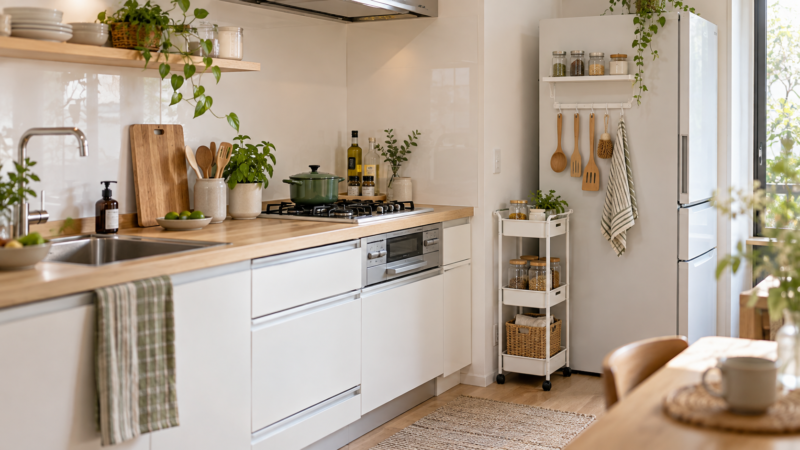
Magnetic hooks and racks can move lightweight everyday items onto a suitable refrigerator side or steel panel.
The important word is “compatible.” A metallic-looking surface does not necessarily attract magnets. Test the exact location and check the manufacturer’s mounting instructions.
Also consider the complete storage footprint. Hanging utensils need space below a hook rail; bottles extend above a rack.
When to skip it
- The intended surface does not attract magnets.
- The product would obstruct a door or appliance access.
- Your stored items exceed the stated load limit.
- The surface finish is delicate or already damaged.
No drilling does not guarantee no scratches. Keep contact surfaces clean, follow the installation instructions, and avoid dragging a loaded organizer across the finish.
For model numbers, dimensions, and limitations of magnetic hooks, a spice rack, and tray holders, see our Yamazaki kitchen storage comparison.
Alternative: Group frequently used items in an existing cabinet tray or rearrange a drawer.
Under-shelf storage: check the shelf and the door
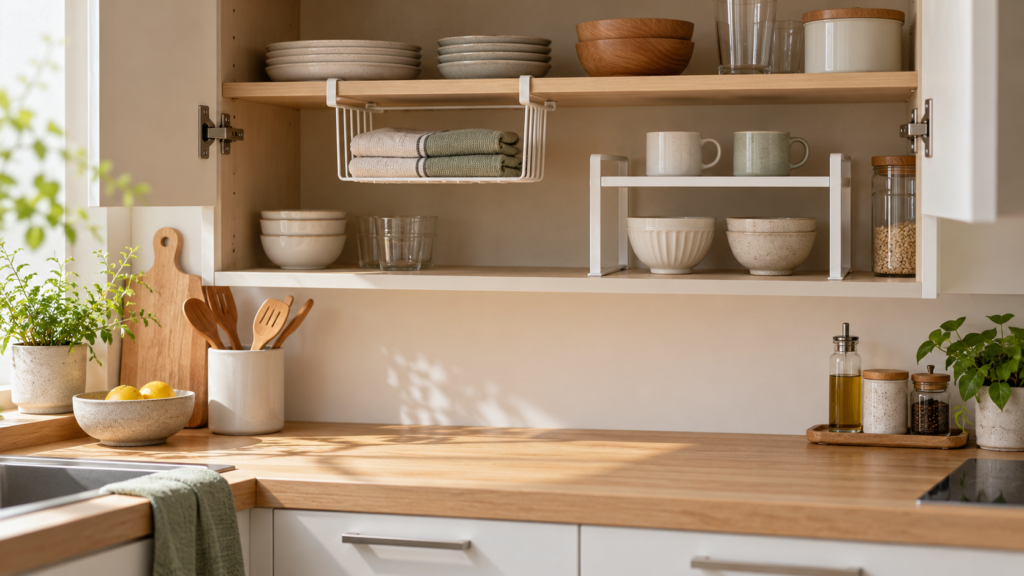
An under-shelf organizer can use space beneath a cabinet shelf without adding another object to the counter.
Compatibility involves more than shelf thickness. Check the cabinet edge, door clearance, and the space needed to remove stored items. Do not force a bracket into place or force a door closed around it.
Product example: Tower Under Shelf Storage Rack
- Model numbers: 2845 (white), 2846 (black)
- Overall dimensions, W × D × H: 30.5 × 26 × 16 cm, approximately 12 × 10.2 × 6.3 inches
- Internal rack dimensions: 30 × 25.5 × 6.5 cm
- Compatible shelf thickness: 1.4–2.5 cm, approximately 0.55–0.98 inches
- Listed load limits: rack 2 kg; each hanger 250 g; each hook 200 g
- Origin: designed in Japan; made in China
The hanger and hook limits are separate from the rack limit. Do not treat the largest number as the capacity of every part.
When to skip it: The shelf falls outside the specified thickness range, the cabinet geometry prevents correct installation, or the organizer interferes with door movement or the work area below.
Alternative: Use a freestanding shelf riser inside the cabinet, if there is enough room.
Official specifications: Tower Under Shelf Storage Rack
Freestanding racks: use height without mounting hardware
A freestanding rack can create an additional storage level inside a cabinet or on a counter.
It avoids attachment to a wall or cabinet edge, but it still needs a stable, suitable supporting surface. Its footprint may also take away space you need for food preparation.
Product example: Tower Adjustable Kitchen Rack
- Model numbers: 5399 (white), 5400 (black)
- Overall dimensions: adjustable width 27–45 cm, depth 20 cm, height 15.2 cm
- Approximate dimensions in inches: width 10.6–17.7, depth 7.9, height 6
- Stated load limit: 5 kg, approximately 11 lb
- Product weight: 1.3 kg, approximately 2.9 lb
- Origin: designed in Japan; made in China
The rack’s own weight and stored items both add to the load on the cabinet shelf beneath it. Check that supporting shelf as well.
Overall height is not the same as usable clearance beneath the rack. Confirm that the items you want to store will fit and remain easy to retrieve.
When to skip it: The rack leaves too little preparation space, does not sit securely, or requires awkward lifting to reach everyday items.
Alternative: Move less-used items elsewhere and keep frequently used dishes on one accessible shelf.
Official specifications: Tower Adjustable Kitchen Rack
Tension-mounted storage: inspect the installation requirements
Tension-mounted products stay in place by applying pressure between supporting surfaces.
Their suitability depends on the exact product, installation span, supporting materials, and load. Pressure can mark or damage unsuitable surfaces, so “no drill” should not be treated as permission to install one anywhere.
This guide does not recommend a specific tension-mounted model. Before choosing one, confirm that its instructions approve your intended surfaces and installation direction.
If those details are unclear, choose a freestanding alternative instead.
No-drill does not mean damage-free
Magnets, brackets, feet, and tension pads all contact a surface. Adhesive products add a different concern: residue or damage during removal.
Before installing:
- Check your lease or building rules and ask the property manager when permission is unclear.
- Inspect and photograph the existing surface condition.
- Follow the exact model’s installation and removal instructions.
- Avoid adding improvised pads or fittings unless the manufacturer allows them.
- Stop using the organizer if it slips, loosens, or leaves marks.
A product described as suitable for renters cannot guarantee how a particular finish will react.
Check the exact model before ordering
The linked product pages are official specification references. They do not establish current US availability.
Match the model number, dimensions, mounting requirements, and included parts with the seller’s listing. Similar names and photographs may refer to different regional products.
Both product examples above are listed as designed in Japan and made in China. Japanese brand origin and manufacturing country are different details.
Start with one reversible change
Choose the method that fits your kitchen’s existing conditions.
No magnetic surface? Skip magnetic storage. A cabinet door will not close? Skip the under-shelf attachment. A rack consumes your only preparation area? Keep that area clear.
The aim is easier cooking and cleaning—not fitting an organizer into every unused space.
Start with one change that is easy to inspect, clean, and remove. If it does not improve daily use, you do not need to add more.
Small spaces. Thoughtful solutions. Inspired by Japan.