Keys rarely need much storage space. The difficulty is giving them a place you actually use when you arrive home with a bag, shopping, or something in your hands.
In a small entryway, a useful setup should help you put things down and collect them again without blocking the door or creating another pile.
Start with your arrival and departure routine, then choose storage that supports it.
Research note: This is a research-based planning guide, not a hands-on product test. Manufacturer information was checked on October 20, 2026. The product example illustrates a storage method rather than a performance ranking. Links are reference links, not affiliate links.
- Follow what happens when you come home
- Decide what really belongs near the door
- A small tray: the simplest starting point
- Hooks: separate items without adding furniture
- A magnetic example: check the mounting method
- Keep everyday bags in their own place
- Test the position with the door open
- Build a short departure check
- Start with one place and one habit
Follow what happens when you come home
Notice where your keys, wallet, transit card, and bag go during an ordinary arrival.
Do you put the shopping down first? Remove your shoes? Carry your bag straight into another room?
The best place for essentials may be just beyond the entryway rather than directly beside the front door.
Try this sequence:
- Enter and close the door.
- Put down what you are carrying.
- Store your keys.
- Move your bag to its usual place.
If using the key storage requires opening a cupboard behind your bag or reaching across a shoe pile, the location may be working against your routine.
Decide what really belongs near the door
Separate daily essentials from things that are only passing through.
| Item group | Possible home | Main consideration |
|---|---|---|
| Keys used every day | Small tray or individual hook | Easy to return and retrieve |
| Wallet and transit card | Regular bag or designated compartment | Avoid unnecessary transfers |
| Tomorrow’s extra item | Small temporary staging spot | Remove it after the trip |
| Mail and receipts | Separate sorting location | Keep them from burying essentials |
You do not need to empty every pocket into a tray.
If your wallet already lives reliably in your everyday bag, leaving it there may be simpler than creating a new place for it.
A small tray: the simplest starting point
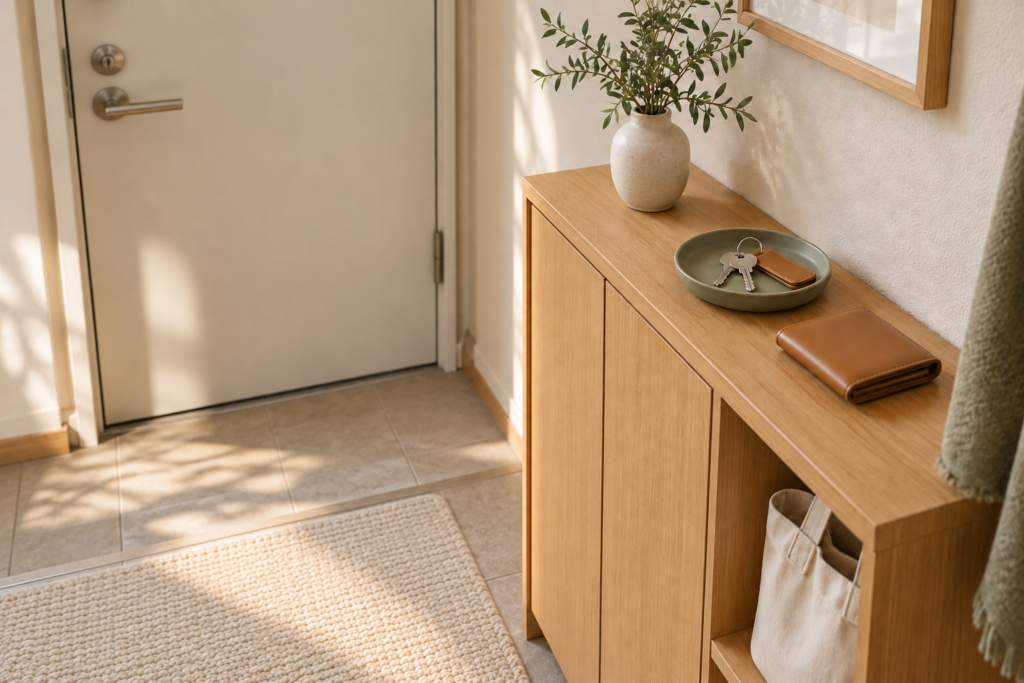
A tray on an existing stable surface creates a clear boundary without installation.
Check its usable interior, not only the outside dimensions. A bulky key fob may occupy more space than a few ordinary keys.
Keep the tray within the surface edges and away from places where opening a door or brushing past could knock it off.
When to skip it: You have no suitable surface, or the tray quickly becomes a place for unsorted mail and miscellaneous items.
Before buying, try a small dish you already own. Use it for several days and see whether you naturally return your keys there.
Hooks: separate items without adding furniture
Individual hooks can make it easier to see which keys are present. For a shared household, assign a position to each person rather than layering everything on one hook.
Account for the hanging items as well as the organizer itself. A long lanyard can swing into a door handle even when the rack looks compact.
Check that you can lift a key ring off without pulling neighboring items down.
When to skip them: The loaded hooks interfere with the door, or the mounting surface does not meet the product’s requirements.
A key hook is not automatically suitable for a handbag. Follow the exact product’s load limits and intended use.
A magnetic example: check the mounting method
Yamazaki’s US Smart Magnetic Key Rack combines hooks with a small shelf.
Its official page describes magnetic mounting and also states that screws are included for wall mounting. Those are different installation methods: using the screws is not a no-drill solution.
Magnetic mounting requires a suitable surface. Do not assume every metal-looking entry door will work. Check the organizer’s instructions, the door material and finish, and any rental restrictions.
Position it so keys and other contents do not interfere with the handle, lock, or door movement.
When to skip it: You cannot confirm surface compatibility, the finish could be damaged, or the only workable installation requires drilling you cannot authorize.
For a broader look at installation choices, see our guide to small entryway storage for renters.
Keep everyday bags in their own place
A small key tray should not have to organize an entire bag.
Choose a stable bag location that leaves the walking route and door swing clear. This might be an existing shelf, a suitable compartment, or another room.
If you use a hook or stand, check its intended use and load limit with the contents of the bag included.
Keep occasional items separate from permanent storage. Something you need to return tomorrow should not become a permanent resident of the entryway.
Test the position with the door open
Before committing to a layout, check the space during real movements.
Open and close the door fully, operate the lock, put on your usual bag, and pass through as you normally would. Include shopping or a coat if those are part of your routine.
Check that:
- Storage does not obstruct the doorway.
- Hanging items do not catch on the handle.
- Keys are not easily visible or reachable from outside.
- You can use the setup without moving shoes or bags first.
Convenient storage does not have to be directly on the door.
Build a short departure check
Choose a brief check based on what you actually carry: keys, wallet or transit card, phone, and any item needed for that day.
The purpose is not to store everything together. It is to make the final check easy.
For shared keys, agree on where they return after use. For occasional items, use one small temporary spot rather than spreading reminders across the entryway.
Start with one place and one habit
Try one designated location before buying a larger organizer.
Return your keys there each time you come home. After several days, check what still goes wrong. Is the location inconvenient? Is the tray crowded? Do you switch bags and leave something behind?
Adjust the specific problem rather than adding storage everywhere.
A successful entryway setup makes arriving and leaving easier while keeping the route through your home clear.
Small spaces. Thoughtful solutions. Inspired by Japan.