A dish rack can save counter space while making the sink harder to use. Another may hold plenty of plates but leave nowhere to prepare dinner.
For a small kitchen, the useful question is not simply how many dishes a rack holds. It is whether you can wash, drain, cook, and put things away without repeatedly moving everything.
This guide compares three placements: inside the sink, across or above the sink, and on the countertop.
Research note: This is a research-based guide, not a hands-on product test. Manufacturer information was checked on October 19, 2026. The product example illustrates a design choice rather than a performance ranking. Links are reference links, not affiliate links.
- Start with your busiest washing-up session
- Compare the three placements
- An in-sink rack: check the basin, not just its opening
- An over-sink rack: check support and loaded height
- A countertop rack: follow the water
- A roll-up example from Yamazaki
- Plan where the rack goes after use
- Try a smaller change before buying
Start with your busiest washing-up session
Think about what you wash together after a typical meal.
A few mugs and plates need a different arrangement from a saucepan, a large mixing bowl, and a cutting board. The number of plate slots does not tell you whether those larger items will fit.
Make a short list of your usual load, then identify the largest or most awkward item.
Also consider when you wash up. If food preparation and dishwashing happen at the same time, keeping part of the sink and counter available may matter more than maximizing drying capacity.
Compare the three placements
| Placement | Space it uses | Main tradeoff |
|---|---|---|
| Inside the sink | Part of the basin | Less room to wash large items |
| Across or above the sink | Sink edges or space above the basin | Support and faucet clearance need checking |
| On the countertop | Work surface beside the sink | Drainage and food-preparation space need checking |
“Over-the-sink” can describe very different products. A low roll-up rack resting on the sink edges is not the same as a tall freestanding rack above the faucet.
Check the actual construction rather than relying on the product name.
An in-sink rack: check the basin, not just its opening
A rack inside the sink can keep draining dishes off the countertop. However, it also occupies part of the washing area.
Measure the basin where the rack will sit. Rounded corners, sloping sides, the drain, and a garbage disposal opening can affect placement.
If the rack rests on ledges or extends across the basin, check its required support surfaces and adjustment range.
Ask whether you can still wash your largest pan and reach the drain without removing the rack.
When to skip it: You have one small basin and need most of it for washing cookware.
An over-sink rack: check support and loaded height
For a low rack spanning the sink, measure the span in the direction the rack will bridge. Check that both ends can rest securely on the surfaces specified by the manufacturer.
The rack’s overall length is not necessarily its maximum supported sink opening.
Then consider the dishes on top. A plate standing upright may interfere with the faucet, a window, or a cabinet even when the empty rack fits.
For a tall freestanding design, also check:
- The full footprint of the legs.
- Clearance above the faucet.
- Room to operate the faucet handle.
- Access to a pull-out sprayer, if fitted.
- Space to lift dishes out without hitting a cabinet.
When to skip it: The support surfaces are unsuitable, or loading the rack blocks everyday use of the faucet and sink.
A countertop rack: follow the water
Before choosing a countertop rack, decide where its water will go.
Some models direct water into the sink through a spout. Others collect water in a tray that needs emptying. Do not assume every tray drains automatically.
Check whether the spout reaches over the sink edge in your intended position. A raised sink rim may prevent the outlet from sitting where it needs to.
Allow for the loaded rack, not just its base. Plates, handles, and utensil holders may extend beyond the footprint.
When to skip it: It occupies your only practical preparation area, or its drainage arrangement does not work with your sink.
A roll-up example from Yamazaki
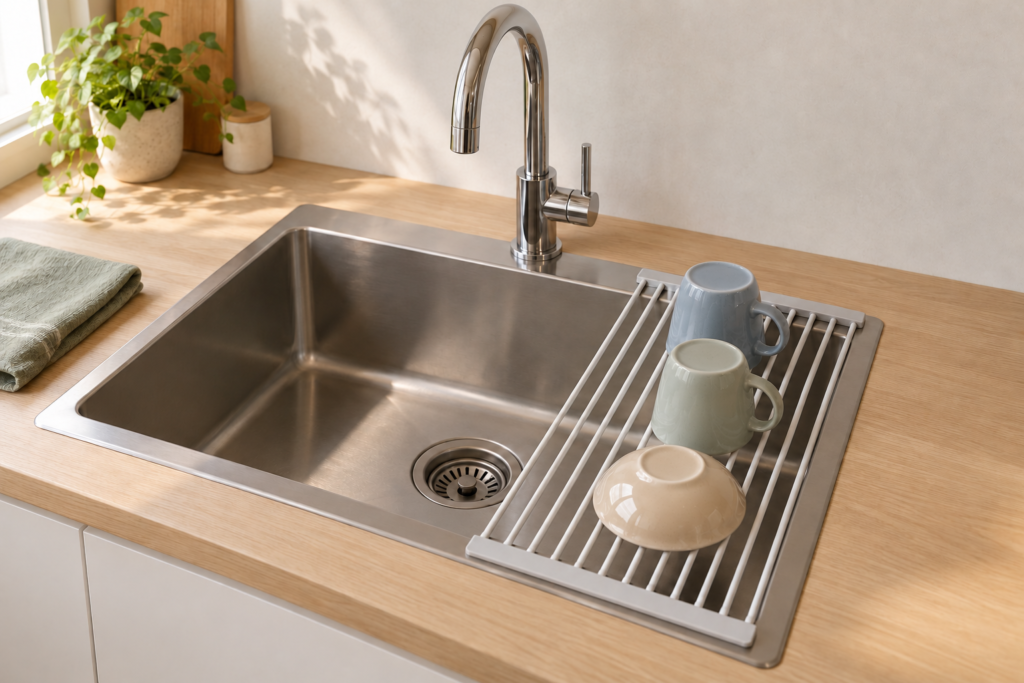
Yamazaki’s US Plate Over-the-Sink Dish Drainer illustrates a low rack that can roll or fold for storage.
That feature may suit a kitchen where the sink needs to be cleared between tasks. It does not remove the need to check the supporting edges, dish stability, and loaded height.
The manufacturer’s FAQ says the rack is not certified dishwasher safe. Follow its cleaning instructions rather than assuming it can go into the dishwasher.
When to skip it: You need a rack that can stay loaded while the entire sink remains available, or you specifically require dishwasher-compatible cleaning.
Check the current product specifications and availability before ordering. Similar-looking models sold in different regions may have different features.
Plan where the rack goes after use
A removable rack still needs somewhere to dry and somewhere to be stored.
Before buying, identify a place where you can:
- Clean the rack and any removable parts.
- Let them dry.
- Store the folded or disassembled shape.
- Retrieve them without moving several other items.
Avoid putting a damp rack into a closed cupboard. A drying mat also needs cleaning and drying; it is not a maintenance-free substitute.
If you expect to leave the rack out permanently, judge how much working space remains when it is full.
Try a smaller change before buying
You may be able to improve your current setup by washing bulky cookware separately, putting dry dishes away sooner, or reducing how many items accumulate at once.
Try mapping a proposed rack’s footprint on a dry counter with paper. Then imagine the tallest plate, the largest pan handle, and the route from sink to cupboard.
For other ways to assess limited kitchen space, see our guide to no-drill storage for renters.
Choose the smallest arrangement that handles your normal washing-up load while leaving room for the next kitchen task.
Small spaces. Thoughtful solutions. Inspired by Japan.