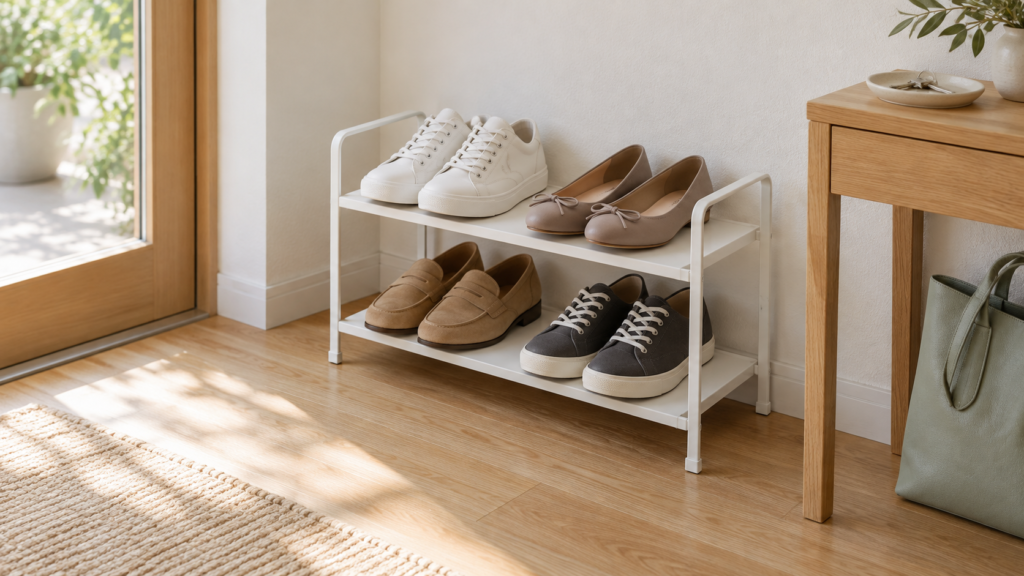
A shoe rack can fit beside your front door while the shoes on it still stick into your walking route.
That is why width alone is not enough. You also need to check the space occupied by your footwear, the height between shelves, and whether you can open the door and remove shoes comfortably.
This guide explains how to choose a rack for a small entryway, with two examples from Japanese brand Yamazaki. The goal is a clear, usable entrance—not the largest possible shoe collection by the door.
Research note: This is a research-based guide, not a hands-on product test. Product information was checked against the linked official US pages on October 15, 2026. The examples are not a performance ranking. Stock, selected variants, shipping, and returns must be checked before ordering. Links are reference links, not affiliate links.
- The short answer
- Start with your daily footwear
- Measure the entrance before the rack
- Rack depth is not loaded depth
- Check shelf clearance, not total height
- Two expandable racks with different trade-offs
- Expandable does not mean adjustable in every direction
- Check the shelf design with your shoes
- Plan for wet shoes and cleaning
- Know when to skip a new rack
- Choose for daily use, not maximum capacity
The short answer
Choose a rack around the shoes you actually use and the space you need to move through.
Check the rack’s minimum width, its depth with shoes in place, usable shelf clearance, and load limits. Then test the doorway with the door open.
If a rack only works when the entrance is empty and the door is closed, it is not a good fit for everyday use.
Start with your daily footwear
Set aside the pairs your household regularly wears. Keep occasional footwear elsewhere if you can.
Look at the actual mix:
- Long sneakers or larger shoes.
- Tall ankle boots.
- Small children’s shoes.
- Narrow heels or sandals.
- Wet or muddy outdoor footwear.
These are different storage problems. A rack that supports adult sneakers may not support small shoes or narrow heels equally well.
Do not treat a stated pair capacity as a guarantee. Your footwear and the rack’s chosen width determine what fits.
Measure the entrance before the rack
Check the proposed location with the front door and nearby cupboard doors open.
Allow space to turn, carry bags, and take shoes off. Also check skirting boards and other obstacles that may prevent the rack from sitting close to the wall.
| Measurement | Check first |
|---|---|
| Width | Rack’s minimum and maximum |
| Depth | Rack plus shoe overhang |
| Shelf clearance | Tallest daily footwear |
| Door movement | Full opening path |
| Access | Taking shoes out and cleaning |
There is no universal walkway measurement recommended in this guide. Preserve a clear route suited to your household and any applicable building requirements.
Rack depth is not loaded depth
A shallow rack may support shoes on two rails while their toes or heels extend beyond the frame.
Measure your longest daily shoe and consider how it will sit on the intended supports. You cannot assume that the manufacturer’s rack depth describes the total space used after loading.
For example, a rack listed as approximately 6 inches deep does not establish that a long sneaker will stay within a 6-inch footprint.
Check product diagrams and support positions. If the fit remains unclear, ask the manufacturer whether the design suits your footwear.
Check shelf clearance, not total height
Overall height does not tell you whether boots fit between shelves.
Look for the clear distance above each shoe-supporting surface. Allow enough room to remove footwear without forcing it against the shelf above.
A top shelf may accommodate taller footwear when space above it is open, but check nearby furniture and the manufacturer’s intended use.
If shelf clearance is not published, treat it as unconfirmed. Do not estimate an exact measurement from a styled photograph.
Two expandable racks with different trade-offs
Yamazaki Line Expandable Shoe Rack, 6-Inch Height — Product 3188
The official US information for the referenced single-tier model lists:
- Overall dimensions at minimum width: 14.96 inches wide × 5.91 inches deep × 5.91 inches high.
- Expansion range: Approximately 15–27.25 inches wide.
- Listed load capacity: 12 lb per tier.
- Material: Steel.
- Origin: Designed in Japan, made in China.
- Assembly: Required.
View Yamazaki’s official Line shoe rack page.
When it may fit: You need low storage and can accommodate the actual shoe footprint.
When to skip it: Your footwear is not adequately supported, or its overhang blocks movement.
Alternative: Consider a deeper rack or shelf suited to your footwear.
The official FAQ says this rack is not designed for stacking. Do not confuse it with the separate two-tier version.
Yamazaki Plain Expandable Shoe Rack, 18-Inch Height — Product 3518
The official US information for the referenced model lists:
- Overall dimensions at minimum width: 16.14 inches wide × 9.84 inches deep × 17.91 inches high.
- Expansion range: Approximately 16.125–27.5 inches wide.
- Listed load capacity: 6.6 lb per tier.
- Material: Steel and wood.
- Origin: Designed in Japan, made in China.
- Assembly: Required.
View Yamazaki’s official Plain shoe rack page.
When it may fit: You want several storage levels and can accommodate the depth and footwear clearance.
When to skip it: Boots cannot fit comfortably, or loaded shoes obstruct the route.
Alternative: Use a layout with space for taller footwear, or keep fewer pairs near the entrance.
The official FAQ says this model is not designed for stacking. Match the selected variant to its specifications before ordering.
Expandable does not mean adjustable in every direction
Both examples expand in width. That does not mean you can change their depth or the distance between storage levels.
Start with the minimum width. If that is already too wide for the available space, the expansion feature will not solve the problem.
Also check how the manufacturer instructs you to secure the chosen width. Assemble the rack fully before loading it, and follow the listed limits.
A larger number of tiers does not automatically mean a higher load allowance. The examples above have different per-tier ratings.
Check the shelf design with your shoes
Rails, mesh, and solid shelves offer different support arrangements.
For a rail design, check where the sole will rest. Small shoes or narrow heels may need a different surface. For mesh, inspect the opening size and whether heels or details could catch.
A solid shelf may support small items more continuously, but still needs suitable clearance and cleaning access.
Do not add an improvised shelf insert unless the manufacturer permits it. An insert can change support, usable height, and load.
Plan for wet shoes and cleaning
Decide where rainwater, dirt, and mud will go.
An open rack is not necessarily a drip tray. A rack placed above other shoes can allow water or dirt to reach them.
Use a suitable separate arrangement for wet footwear, and follow the footwear and rack care instructions. Check that any tray fits without creating a new trip obstacle.
Before buying, consider whether you can clean under and behind the rack. A design that is hard to move or access may make a small entrance more difficult to maintain.
Know when to skip a new rack
You may not need another organizer if a smaller daily shoe selection fits neatly in storage you already own.
Skip a candidate rack when:
- Its minimum size is too large.
- Loaded shoes block a door or walking route.
- Your footwear does not fit or stay supported.
- Required installation is unsuitable for your rental.
- You cannot clean around it comfortably.
Neither product example should be used as a seat or step.
For the wider entrance plan, see Small Entryway Storage Ideas for Renters: What Fits Without Drilling?.
Choose for daily use, not maximum capacity
The most useful shoe rack lets you find a pair, take it out, return it, and move through the entrance without rearranging everything.
Before ordering, match the exact model and variant, confirm dimensions and load limits, and check current stock and return conditions.
A few well-placed daily pairs can serve a small entryway better than a full rack that makes leaving home awkward.
Small spaces. Thoughtful solutions. Inspired by Japan.