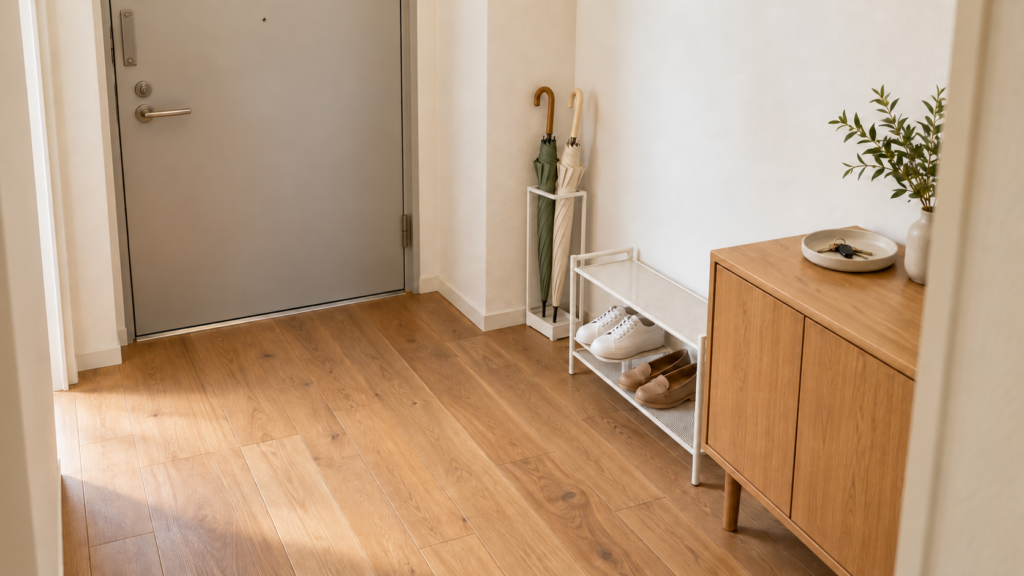
A small entryway has several jobs to do. It needs to let you open the door, take off your shoes, put down everyday essentials, and leave again without searching for your keys.
Adding storage can help—but only if it does not make those tasks harder.
This guide compares simple no-drill approaches for shoes, keys, and umbrellas, with two product examples from Japanese brand Yamazaki. Start with the space you need to move through, then decide what storage can fit around it.
Research note: This is a research-based guide, not a hands-on product test. Product specifications were checked against the linked official pages on October 14, 2026. The regional pages are specification references; US availability and equivalent regional models have not been verified. Links are reference links, not affiliate links.
The short answer
Keep the doorway and walking route clear. Give frequently used items a small, predictable place, and store less-used items elsewhere.
For renters, the simplest options may be a tray on an existing surface, a freestanding shoe rack, or magnetic storage on a suitable surface.
No-drill does not automatically mean damage-free. Check the mounting conditions, surface finish, and your rental agreement before installing anything.
Measure the space with the door open
A closed door can make an entryway look more spacious than it is.
Before choosing storage, check:
- The full movement of the front door and nearby cupboard doors.
- The route you use while carrying bags or groceries.
- Space to stand, turn, and put on shoes.
- Skirting boards, handles, switches, and other obstacles.
- How far stored items will project beyond the organizer.
Mark a proposed floor footprint with paper, then test your normal movements without placing anything in the doorway.
Do not choose a rack solely because its frame fits. Shoes, umbrella handles, and hanging items can extend beyond its listed dimensions.
Match the method to the problem
| Problem | Start with |
|---|---|
| Missing keys | A tray or suitable magnetic rack |
| Shoes on the floor | Keep daily pairs; check rack dimensions |
| Dripping umbrellas | A stand with manageable drainage |
| Crowded doorway | Move storage away from the entrance |
You do not need a separate organizer for every item. An existing shelf and a small tray may solve the key problem without adding furniture.
Give keys a place you can reach easily
Choose a place that works when you arrive with your hands full.
A tray on an existing cabinet is straightforward and needs no mounting. A magnetic rack can free that surface, but only when the mounting area is compatible.
Do not assume that every metal-looking door attracts magnets. Check the actual surface and the product’s installation instructions.
If mounting on a moving door, check where the rack and hanging keys will travel as the door opens. They should not hit a wall, obstruct the handle, or interfere with normal operation.
Yamazaki Smart Magnetic Key Rack With Tray — 2754 / 2755
The linked official page lists:
- Models: 2754, white; 2755, black.
- Dimensions: 24.5 × 4.5 × 6 cm, approximately 9.6 × 1.8 × 2.4 inches, width × depth × height.
- Listed load capacity: 2 kg total.
- Origin: Designed in Japan, made in China.
View Yamazaki’s official key rack specifications.
The rack has six hooks and includes a magnet and wood screws. This guide’s no-drill option is magnetic installation on a suitable surface.
When to skip it: The surface is unsuitable, the rack interferes with door movement, or your items cannot stay within the specified load.
Alternative: Use a small tray on an existing stable surface.
Store daily shoes, not your entire collection
Before buying a shoe rack, decide which pairs genuinely need to stay by the entrance.
Moving occasional footwear elsewhere may solve the problem more effectively than a larger rack.
If you still need one, check:
- Its minimum and maximum width.
- Depth with your own shoes in place.
- Shelf spacing for taller footwear.
- Weight limits and assembly requirements.
- Space to remove shoes and clean underneath.
An expandable rack changes width; it does not necessarily change depth or shelf height.
Treat a stated shoe capacity as a guide rather than a promise for your household. Boots, large sneakers, and children’s shoes occupy space differently.
When to skip it: Shoes project into the walking route, or the rack blocks a door even at its smallest setting.
Alternative: Keep a smaller daily selection by the entrance and use existing cupboard space for the rest. Do not use an ordinary shoe rack as a seat unless it is specifically designed for that purpose.
Plan where umbrella water will go
A narrow umbrella stand can fit beside a cabinet and still be awkward to use.
Check the footprint, but also allow room for umbrella handles, taking umbrellas out, and removing any drip tray.
A tray collects water; it does not remove the need to empty and clean it. Follow the product’s care instructions and avoid leaving puddles on the surrounding floor.
Yamazaki Tower Slim Umbrella Stand — 4928 / 4929
The linked official page lists:
- Models: 4928, white; 4929, black.
- Dimensions: 22 × 12 × 50 cm, approximately 8.7 × 4.7 × 19.7 inches, width × depth × height.
- Weight: 2.2 kg.
- Origin: Designed in Japan, made in China.
View Yamazaki’s official umbrella stand specifications.
The stand has a removable water tray and requires no assembly.
When to skip it: You cannot reach the tray comfortably, umbrella handles obstruct movement, or the stored umbrellas are not suitably supported.
Alternative: Choose a stand matched to your umbrella types and the space available. Short folding umbrellas need a different fit check from long umbrellas.
No-drill still needs a surface check
Magnets can move against a finish. Freestanding storage can rub against walls or floors. Adhesive products can leave residue or lift a coating.
Follow the specific product’s instructions rather than treating “renter-friendly” as a guarantee.
If an installation would change the property, check your rental agreement or ask the landlord first. Avoid adding pads, spacers, or other modifications to a mounting system unless the manufacturer permits them.
For a related comparison of mounting methods, see Japanese Kitchen Storage for Renters: No-Drill Solutions.
Check the exact regional model
Similar names and photographs do not establish that two products have identical specifications.
Before ordering, match the model, dimensions, mounting method, and load limits to the seller’s listing. Confirm delivery and returns for your location.
The Yamazaki examples here are Japanese-designed products listed as manufactured in China. Brand origin and manufacturing country are different facts.
Start with one useful change
Choose the problem that causes the most friction: missing keys, scattered shoes, or wet umbrellas.
Solve that one problem, then test the entryway during normal arrivals and departures. Can you open the door, carry bags, find what you need, and clean the floor comfortably?
If the answer is yes, you may not need another organizer.
Small spaces. Thoughtful solutions. Inspired by Japan.