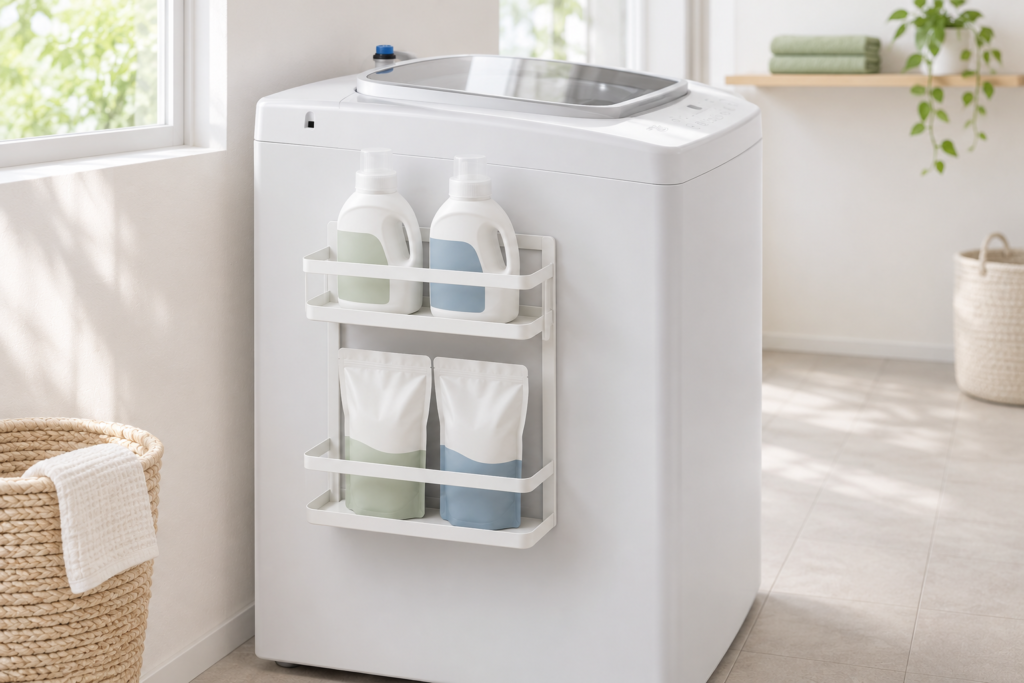
Laundry detergent storage can look tidy and still be difficult to use. A tall bottle fits beneath a shelf but cannot be lifted out. Refill pouches fall behind it. A narrow rack holds the bottles, but their handles project into the walkway.
Start by separating the products currently in use from unopened refills. Then choose a position that works with the containers you actually buy—and their storage instructions.
Separate daily products from refill stock
Gather the laundry products stored around your washing machine.
Put the products currently in use in one group. Keep unopened refills and occasional-use products in another.
The daily group should be easy for the intended user to reach and return. Refills can occupy a less convenient shelf, provided the location meets the product’s storage requirements.
Choose the amount of stock around the space available. If new purchases regularly overflow into the walking route, reduce the reserve before adding another organizer.
Set storage requirements before choosing a location
Follow each product’s label for storage and refilling.
Keep products identifiable in their original labeled packaging, using manufacturer-specified containers when refilling. Do not transfer detergent into food or drink containers.
Where children may have access, prioritize secure storage over an open display. The American Cleaning Institute recommends keeping liquid laundry packets closed in their original packaging and in a high, out-of-sight cabinet secured with a child safety lock.
An accessible washing-machine side rack is not a substitute for secure storage. Choose a cabinet arrangement when an open rack would make products reachable by children or others who might handle them unintentionally.
Measure the bottle and the movement
Check containers when full, including their caps, handles, and dispensing parts.
| What to check | Why it matters |
|---|---|
| Bottle width and depth | Handles may project beyond the base |
| Full bottle height | Caps or pumps may meet the shelf above |
| Removal clearance | You need room to lift a bottle over a retaining rail |
| Filled weight | Glass, liquid, and packaging all contribute |
| Refill pouch shape | Flexible packs may slump or widen when stored |
A bottle that fits inside a shelf is not necessarily easy to remove.
Try the movement with an actual container before committing to the layout. Avoid arrangements that require squeezing a pouch or tilting a bottle against neighboring products.
Compare three storage methods
| Method | Potential advantage | Main limitation |
|---|---|---|
| Cabinet shelf | Can keep products out of sight and support secure storage | Requires usable height and easy access |
| Existing tray on a suitable shelf | Groups daily products and simplifies wiping underneath | Does not provide child security by itself |
| Magnetic side rack | Uses a compatible washing-machine side panel | Requires surface compatibility, load checks, and secure placement |
1. Give daily products a defined cabinet section
Use an existing shelf if you can remove the bottle without moving several other items.
Place labels where they are easy to read. Keep refills in a separate section so that they do not block the open bottle.
Check the shelf’s load limit and the cabinet’s internal dimensions, including hinges and door hardware.
When to skip: Choose another position if a heavy bottle must be lifted from an awkward height or if its cap catches on the shelf above.
2. Try a tray you already own
A suitable tray can keep a few daily products together on a stable shelf.
Choose a size that leaves room to grip the bottles. Check that its material is compatible with the products and follow label instructions for any spills.
Move bottles individually if lifting the loaded tray would be heavy or unstable.
When to skip: A tray is not enough when the products require secured storage or when its rim makes bottles difficult to remove.
3. Consider a magnetic side rack
A magnetic rack may work on a suitable flat steel surface where the appliance manufacturer permits attachments.
Check both the organizer instructions and the washing machine’s requirements. Leave access to hoses, filters, controls, and service areas, and preserve required appliance clearances.
Measure the loaded rack’s projection into the surrounding space. Do not place products where they obstruct the door, lid, detergent drawer, or walking route.
When to skip: Use a cabinet or fixed shelf if the surface is incompatible, attachments are prohibited, or the position would allow unintended access to detergent.
Product example: Tower Magnetic Laundry Side Rack
Yamazaki’s Tower Magnetic Laundry Side Rack provides two shelves and two accessory hooks.
| Specification | Manufacturer information |
|---|---|
| Overall size | W28 × D11.5 × H40 cm |
| Materials | Steel, magnet, and silicone |
| Load limit per shelf | 2 kg |
| Load limit per hook | 250 g |
| Total listed load | 4.5 kg |
| Origin | Designed in Japan; made in China |
The 4.5 kg total is not a single-shelf allowance. Check each shelf and hook separately, including the weight of the filled containers.
The linked page is the manufacturer’s European reference. Check current availability and delivery coverage for your location.
Give refill pouches support without compressing them
Keep refills in their packaging with product names visible.
A suitable existing bin can help flexible packs stay together, but avoid packing them so tightly that they must be pulled out by their spouts or corners.
Do not place heavy items on refill pouches. The Japan Soap and Detergent Association notes that stacking, heavy objects, and contact with sharp items can damage refill packaging.
Check the oldest stock before buying more, following the product’s guidance on storage and use.
Test the full laundry routine
Before buying an organizer, check the layout during a normal load:
- Open the washing machine and detergent drawer.
- Take out the product you need.
- Measure or dispense it according to the label.
- Close the package and return it to its designated storage.
- Check for spills and wipe the surrounding area as appropriate.
If your existing cabinet or shelf works after separating daily products from stock, you may not need another rack.
For nearby items, see our guides to laundry hanger storage and choosing a laundry basket for a small space.
Useful detergent storage makes the daily routine straightforward while keeping labels visible, refills manageable, and products appropriately secured.
Sources: Manufacturer specifications linked above; American Cleaning Institute storage guidance; Japan Soap and Detergent Association storage guidance. Product specifications checked on November 11, 2026. This is a research-based guide, not a hands-on product review.
Small spaces. Thoughtful solutions. Inspired by Japan.