Slippers can take over a small entryway even when there are only a few pairs. Everyday slippers wait beside the door, guest pairs fill a basket, and the shoes you just removed need somewhere to go.
Start by separating slippers used every day from those brought out for visitors. They do not necessarily need the same storage location.
Everyday pairs need an easy return spot. Guest pairs can often live farther from the doorway, leaving more room to step inside and remove shoes.
Choose the return spot before the organizer
Think about where you change from outdoor shoes into slippers—and where you take the slippers off again.
The most useful storage position is somewhere you can reach during that routine without stepping over a rack or opening a cabinet behind another person.
If you usually remove your slippers near the living room, keeping them at the front door may create an extra trip. Give them a position that fits your actual movement through the home.
For a household using only one or two pairs, a defined floor position outside the walking route may be enough.
Separate everyday and guest slippers
Keep regularly used pairs accessible. Store clean, dry guest slippers together on a suitable shelf or in an existing container.
Check the slippers’ care instructions before washing or drying them. Let damp pairs dry before putting them into enclosed storage.
Keep outdoor shoes and slippers in distinct sections if they share a cabinet or rack. Consider where the soles will rest and what they will touch.
Guest storage should also be easy to identify. A complicated arrangement that requires moving several boxes may be frustrating when someone arrives.
Measure the slippers in their stored position
A rack’s depth is not always the depth of the loaded arrangement.
Slippers may project above or beyond the frame, particularly if they have thick soles, padded uppers, or a closed heel.
| What to check | Why it matters |
|---|---|
| Length of the largest slipper | Toes or heels may extend beyond the organizer |
| Thickness of a paired set | Bulky uppers may not fit a narrow slot |
| Loaded width and depth | The slippers may project into the walkway |
| Removal space | You need room to lift or slide a pair out |
| Nearby doors | Cabinet and entrance doors must open freely |
Try holding one pair in the proposed position before buying a rack. Check whether the pair stays together without being squeezed into an unsuitable shape.
Compare four storage methods
| Method | Potential advantage | Main limitation |
|---|---|---|
| Defined floor position | No new organizer needed | Uses floor space and can spread out |
| Open basket | Easy to move and use for guest pairs | Pairs can become mixed or buried |
| Dedicated rack | Gives slippers a visible return point | Must fit the slipper shape and available space |
| Cabinet shelf | Keeps occasional-use pairs out of sight | Requires accessible space inside |
1. Reserve a small floor position
If you use only one pair, try giving it a clear position beside a wall.
Keep it away from the door swing, step edge, and route used to enter the home. Make sure it does not occupy the space needed to remove outdoor shoes.
When to skip: Choose another arrangement if the slippers regularly slide into the walking route or become mixed with outdoor shoes.
2. Use an existing open basket
A basket can be practical for a small number of guest pairs.
Arrange each pair together rather than dropping individual slippers into a pile. Choose a container whose inside and base you can clean.
Avoid packing it tightly. If taking out one pair brings several others with it, reduce the contents or use a shelf instead.
When to skip: Deep baskets are less useful when smaller pairs disappear beneath larger ones or soft slippers become compressed.
3. Give slippers a dedicated rack
A rack can make the return position obvious and keep pairs arranged in a consistent way.
Check the loading method. Some designs hold slippers upright, some support them on bars, and others require the soles to face each other.
Follow the manufacturer’s arrangement rather than forcing bulky slippers into a narrow opening.
When to skip: A rack is not useful if it makes the entryway harder to walk through or requires you to bend and rearrange several pairs whenever you use it.
4. Use a cabinet shelf for occasional-use pairs
A shelf can work well for clean, dry guest slippers.
Keep them in a defined section, away from items that would fall onto them when the cabinet opens. Check the usable shelf height and the clearance around hinges.
A shallow tray or container you already own may help keep the pairs together.
When to skip: Avoid a position that requires moving everyday shoes each time you need guest slippers.
Product example: Line Slipper Rack
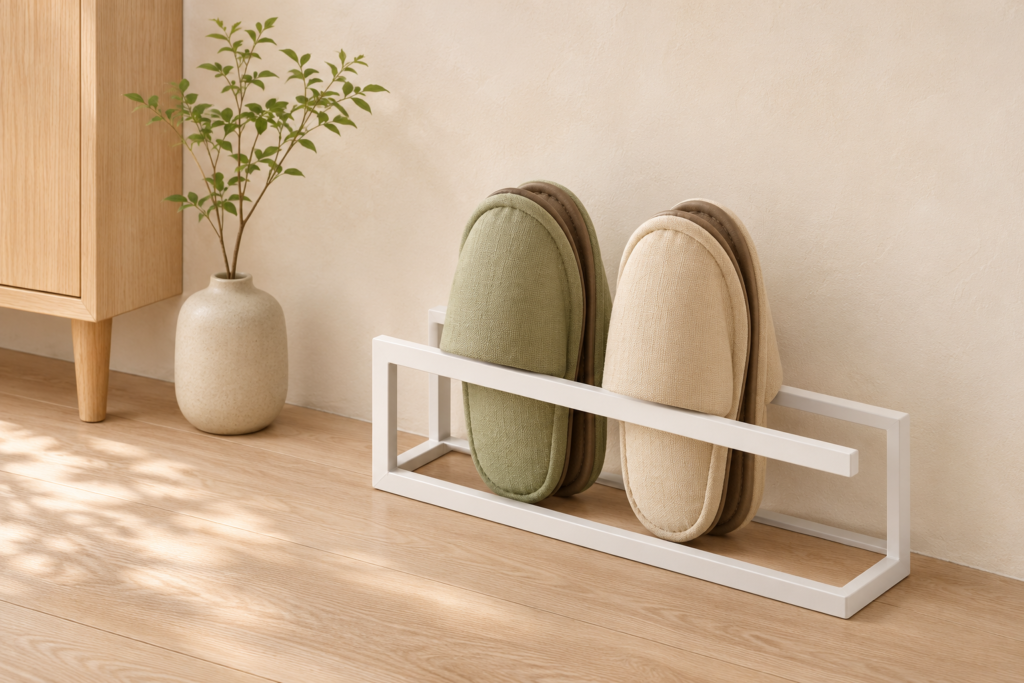
The Line Slipper Rack from Yamazaki is a low, freestanding option.
| Specification | Manufacturer information |
|---|---|
| Overall size | W42 × D10.5 × H14 cm |
| Main material | Steel |
| Origin | Designed in Japan; made in China |
| Assembly | Not required |
Its low profile may suit a clear stretch of wall, but check the total space occupied by your slippers and the room needed to remove them.
The linked European page contains differing capacity descriptions. Choose it based on verified fit for your own pairs rather than assuming a specific number will fit.
Use the page as an English-language manufacturer reference, and check current availability and delivery coverage for your location.
Try the arrangement before buying
Mark out the proposed storage area with a sheet of paper or another removable guide.
Place your slippers there and run through the normal routine:
- Enter with a bag.
- Remove your outdoor shoes.
- Take out the slippers.
- Return them when leaving.
- Check how easily the floor can be cleaned.
If an existing shelf, basket, or defined floor position works, a new rack may not be necessary.
For other items sharing the doorway, see our guides to everyday bag storage and umbrella storage in a small entryway.
Useful slipper storage gives everyday pairs an easy return point while keeping occasional-use pairs from taking over the entrance.
Research note: Product information checked against the manufacturer’s official pages on November 7, 2026. This is a research-based guide, not a hands-on product review. Fit depends on the size and shape of your slippers.
Small spaces. Thoughtful solutions. Inspired by Japan.